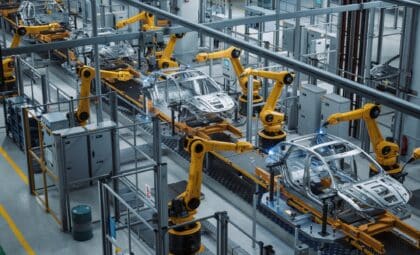


Audi’s long-considered plan to establish a manufacturing plant in the United States has come to an abrupt stop. What once seemed like a strategic leap forward for the German brand now appears entangled in a complex geopolitical and economic landscape. The situation illustrates how swiftly industrial ambitions can collide with political realities.
In early 2023, Audi was optimistic. Substantial federal subsidies under the Inflation Reduction Act made local production in the U.S. financially appealing, especially with the electric vehicle market expanding rapidly. But over the course of 2025, the promise of expansion has eroded under the weight of punitive tariffs, particularly a 25% import duty imposed on foreign-built cars and light trucks.
A Strategic Freeze Tied to Rising Costs
According to Handelsblatt, Oliver Blume, CEO of the Volkswagen Group, which owns Audi, confirmed that the brand’s U.S. factory project has been “put on hold.” The reason? The tariff bill has already drained more then $ 2 billion USD from the group’s cash flow during the first nine months of 2025. That figure, revealed in an interview with Handelsblatt, makes it increasingly difficult to justify further investment in a region where regulatory stability is missing.
Blume stated bluntly: “As long as the tariffs remain in place, a significant additional investment in the United States is not viable.” The proposed plant in Chattanooga, Tennessee, once a centerpiece of Audi’s North American strategy, is now indefinitely shelved.

Ripple Effects Across the Industry
Audi isn’t the only one feeling the sting. Other European automakers such as BMW and Mercedes-Benz, along with Stellantis, face similar challenges. Their profit margins in the U.S., long among their healthiest globally, are under pressure. The tariff shock not only makes European-built vehicles less competitive, it has also created delays in customs clearance, particularly for recently shipped Audi models stuck in U.S. ports.
What makes the issue especially delicate is its secondary impact. Many French factories manufacture components, engines, chassis parts, for German vehicles. If final assembly lines in Germany slow down because U.S.-bound cars are no longer profitable, French suppliers from regions like Hauts-de-France, Auvergne-Rhône-Alpes, or Grand Est could see their production cut back. Valeo, Plastic Omnium, and Forvia are among the companies at risk, reports Auto Plus

The European Response Still Uncertain
In Brussels, the European Commission has prepared a retaliatory package reportedly targeting up to more then $100 billion USD worth of American goods. Medical devices, industrial machinery, and IT hardware are among the potential targets. For now, the EU is holding back, prioritizing diplomatic channels. But this restraint may not last if pressure from national governments or the automotive sector intensifies.
Although the Inflation Reduction Act, passed under the Biden administration, was designed to encourage local EV production, the return of Donald Trump to the presidency has brought a renewed emphasis on tariffs. For foreign automakers, the combination of lingering incentives and reinforced trade barriers creates a complex and uncertain investment environment.