
CEO Elon Musk made the announcement via his platform X, marking a major change to how the company offers its advanced driver-assist technology.
The update means Tesla drivers will no longer be able to pay $8,000 upfront for access to FSD (Supervised), and will instead need to subscribe monthly at $99 in the U.S. The decision aligns with broader adjustments in Tesla’s automation strategy and comes amid regulatory investigations into the system’s safety.
The National Highway Traffic Safety Administration (NHTSA) launched an investigation last year into nearly 2.9 million Tesla vehicles equipped with FSD. The probe was prompted by more than 50 reports of traffic safety issues and several crashes. At the same time, Tesla continues to promote FSD as a feature that reduces driving stress while requiring constant driver supervision.
FSD Will No Longer Be Sold for a One-Time Fee
Elon Musk confirmed on Wednesday that after February 14, Tesla will stop offering FSD for purchase. Instead, customers will only be able to access it through a monthly subscription. “Tesla will stop selling FSD after February 14. FSD will only be available as a monthly subscription thereafter,” Musk wrote.
Tesla has not said whether the current $99/month subscription will remain unchanged once the one-time payment option is discontinued. Tesla also hasn’t confirmed whether this change affects customers who previously purchased the feature outright.
Currently, FSD is available in the United States, Canada, China, Mexico, Puerto Rico, Australia, and New Zealand, with the company stating that it “will come to other regions in future updates.” Tesla uses the label “FSD (Supervised)” for the version offered to the public, distinguishing it from an unsupervised variant used internally to move vehicles from assembly lines to delivery areas, according to Reuters.
Tesla will stop selling FSD after Feb 14.
— Elon Musk (@elonmusk) January 14, 2026
FSD will only be available as a monthly subscription thereafter.
FSD Supervised Is Not Autonomous Driving
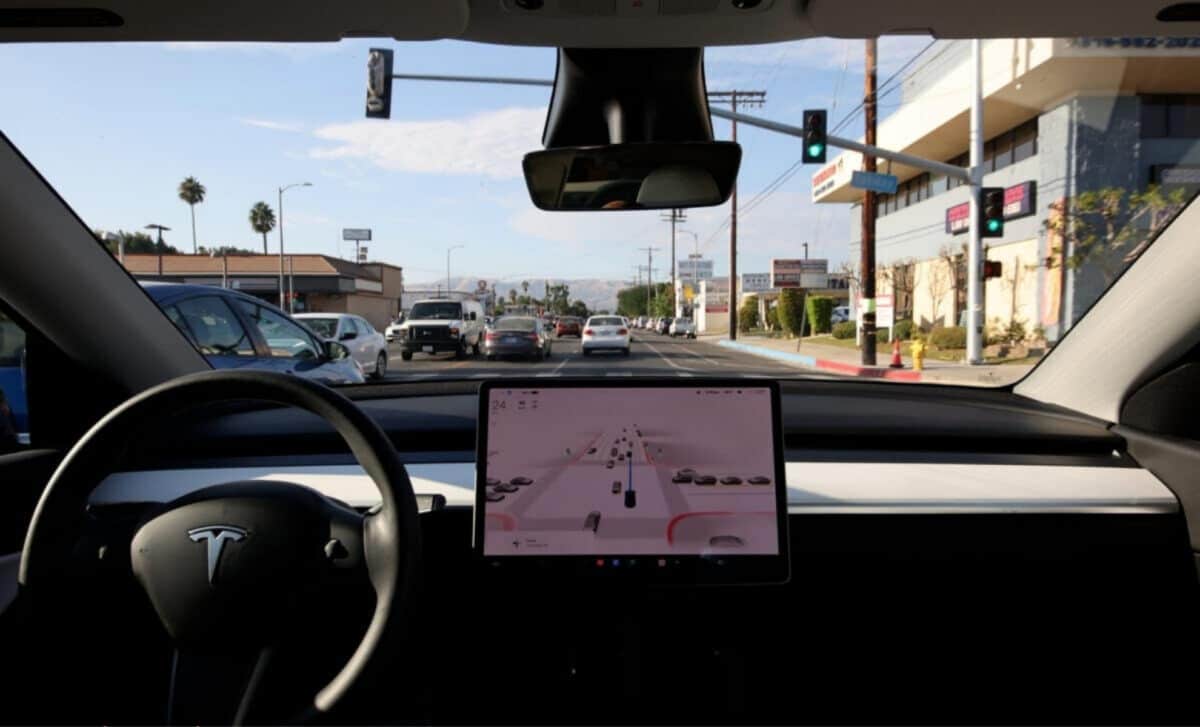
Tesla describes FSD (Supervised) as a system that performs tasks such as route navigation, steering, lane changes, parking, and responding to traffic signals, while still requiring active human oversight. The company explains that the feature “intelligently and accurately completes driving maneuvers for you… under your active supervision.”
The company stresses that FSD does not make Tesla vehicles autonomous. On its website, Tesla says: “None of these advanced driver assistance features make your Tesla vehicle fully autonomous or replace you as the driver.” Drivers must remain alert and ready to take control at all times.
Tesla claims FSD (Supervised) improves road safety. According to its Vehicle Safety Report, vehicles using the feature experience seven times fewer major and minor collisions, and five times fewer off-highway collisions, compared to those driven without it. The system is trained using “billions of miles of anonymous real-world driving data,” according to the company.
Tesla encourages drivers to use FSD for daily commutes, errands, and road trips, while emphasizing that driver responsibility remains critical.
NHTSA Investigates ‘Mad Max’ Mode Amid Safety Concerns
As Tesla transitions its FSD business model, federal regulators continue to examine how the system functions in real-world conditions. The NHTSA’s ongoing investigation into the FSD-equipped fleet follows multiple crash reports and concerns over traffic law compliance.
Another area of scrutiny is a driver-assistance mode known as “Mad Max”, which reportedly operates at higher speeds and in a more aggressive manner. Social media users have described the mode as allowing Teslas to “accelerate and weave through traffic at an incredible pace… like a sports car.” Tesla recently reposted such a description without further comment.
NHTSA responded to the reports by stating: “NHTSA is in contact with the manufacturer to gather additional information.” The agency emphasized that “the human behind the wheel is fully responsible for driving the vehicle and complying with all traffic safety laws.”
Tesla has not issued a formal response to the probe into “Mad Max” mode. It remains unclear whether this internal mode is available to consumers or still under internal testing. According to Reuters, the version of FSD Tesla uses internally to move cars around factory lots is unsupervised, unlike the consumer-facing version.