
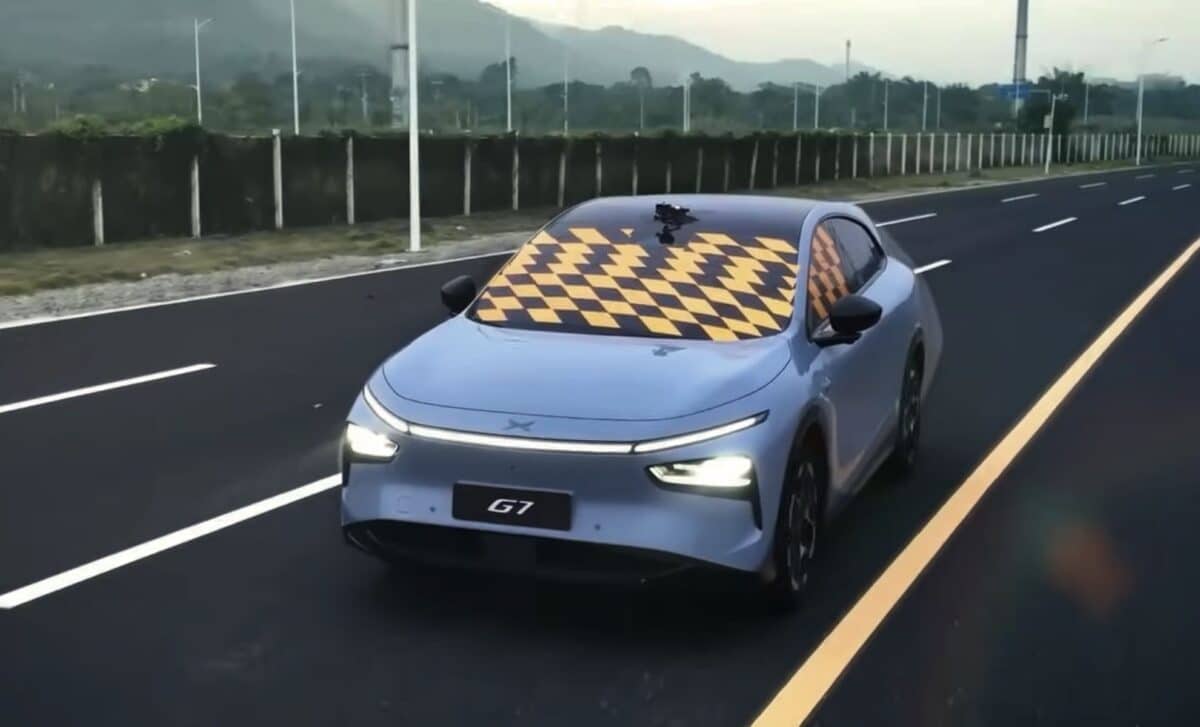
The Xpeng G7 underwent a series of extreme challenges designed to push its AI to the limit. The stunt was not just a flashy experiment; it aimed to showcase the evolution of driver assistance systems and reaffirm Xpeng’s growing influence in the intelligent vehicle market.
Xpeng’s rapid rise within China’s competitive EV sector has largely been powered by its advanced software features, particularly in autonomous navigation. The G7, an SUV that launched with over 10,000 orders, is one of its flagship models, carrying the brand’s NGP system—an AI suite designed to handle complex urban driving. To demonstrate the system’s real-world capability, Xpeng engineers decided to tape over the windshield and hand over control to the AI, under carefully structured but unforgiving test conditions.
Obstacle Avoidance at High Speed
The first trial challenged the G7 with a classic three-lane cone avoidance test. Without any visual input from a driver, the vehicle had to detect and maneuver around cones laid out across three lanes. It performed the task without knocking over or touching a single one. The presenter commented mid-test, “I don’t think Tesla FSD can do that,” noting the clean execution.
Next came a smaller-scale detection challenge: identifying and avoiding a single bottle of Coca-Cola placed on the road. While the object wasn’t visible at a distance via the external camera, the onboard sensors kicked in as the car approached.
The G7 made a smooth and precise swerve to avoid the bottle, which never came close to being hit. These first two scenarios demonstrated not only object detection, but refined spatial judgment—without visual confirmation from a human.
Ai-Powered Reactions Under Pressure
The third test added motion and unpredictability into the mix. The vehicle was confronted with a teddy bear thrown into its path while driving at speed. It reacted in real time, automatically avoiding the soft object without hesitation. The presenter attributed the system’s responsiveness to “its three Turing chips,” which enabled it to process input and execute maneuvers “in a split second.”
In the final scenario, a piece of debris dropped from the car in front—simulating a common real-world driving hazard. Once again, the AI responded rapidly, swerving the G7 away from the object without any loss of stability. According to Supercar Blondie, this performance reinforced the system’s ability to function in urgent and unpredictable environments.
NGP System Confirms Its Promise
The tests provided a high-stakes showcase for Xpeng’s NGP system (Navigation Guided Pilot), originally launched in 2022. At the time, it positioned the brand as the first automaker in China to introduce such advanced support for urban driving. In the G7 trials, NGP worked without visual support, handling all four tests on its own.
Following the successful demonstrations, the presenter concluded, “I think we proved that the Xpeng NGP system is actually very impressive and handles all of [the] scenarios smoothly.” This blend of confidence and empirical performance added weight to the claim that the G7’s AI is more than just hype—it’s a serious technical achievement.