

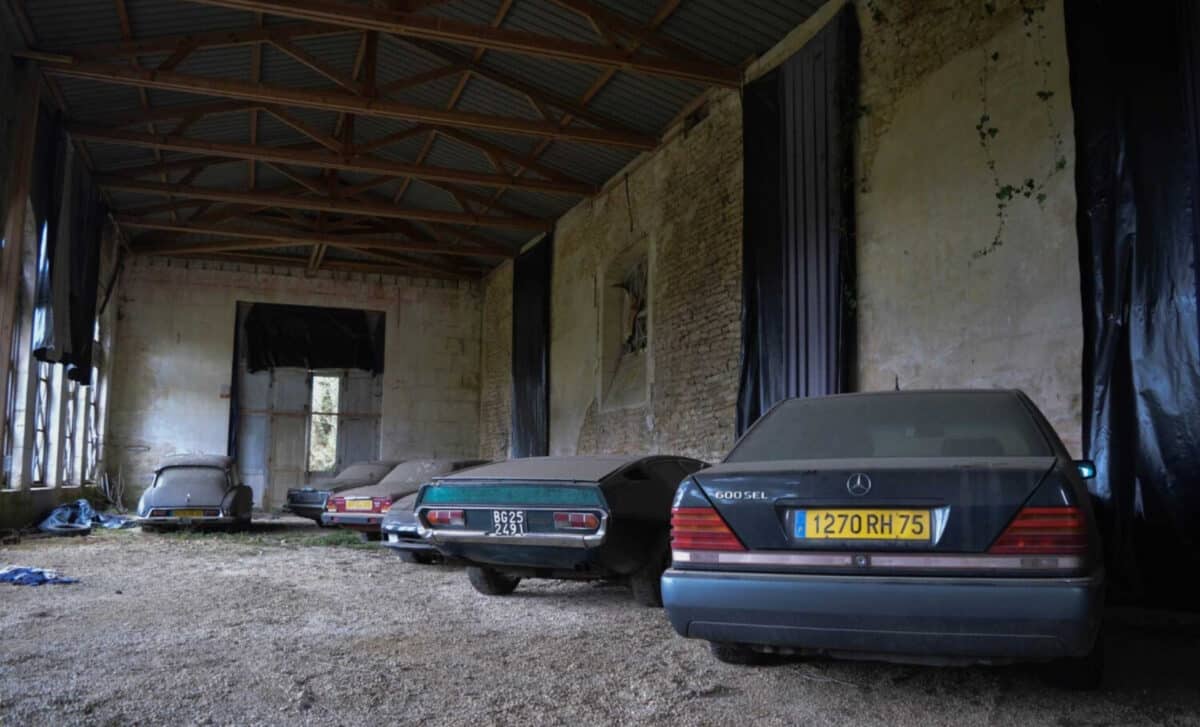
The discovery reveals a collection that blends luxury, performance, and history. Urbex, an unofficial activity centered on exploring long-abandoned places, sometimes yields unusual finds. In this case, it revealed what can be described as genuine automotive treasures.
The barn was open to the wind, with the cars exposed to dust, bird droppings, and patches of moss. Yet the six vehicles were carefully aligned, as if parked deliberately before being left behind.
A Mercedes S-Class and a Dodge Stealth from the 1990s
The most recent model in the barn is a Mercedes S-Class W140, the very first generation of that series, launched in 1990. It is identified as a V140 version, meaning it features a long wheelbase. The “SEL” badge at the rear confirms this extended configuration.
Next to it stands a Dodge Stealth, a model rarely seen in France. Sold between 1990 and 2000, it is the North American counterpart to the Mitsubishi 3000 GT. As reported by Auto Journal, both the German sedan and the American coupe appear well preserved overall, covered only by a thin layer of dust and organic residue.
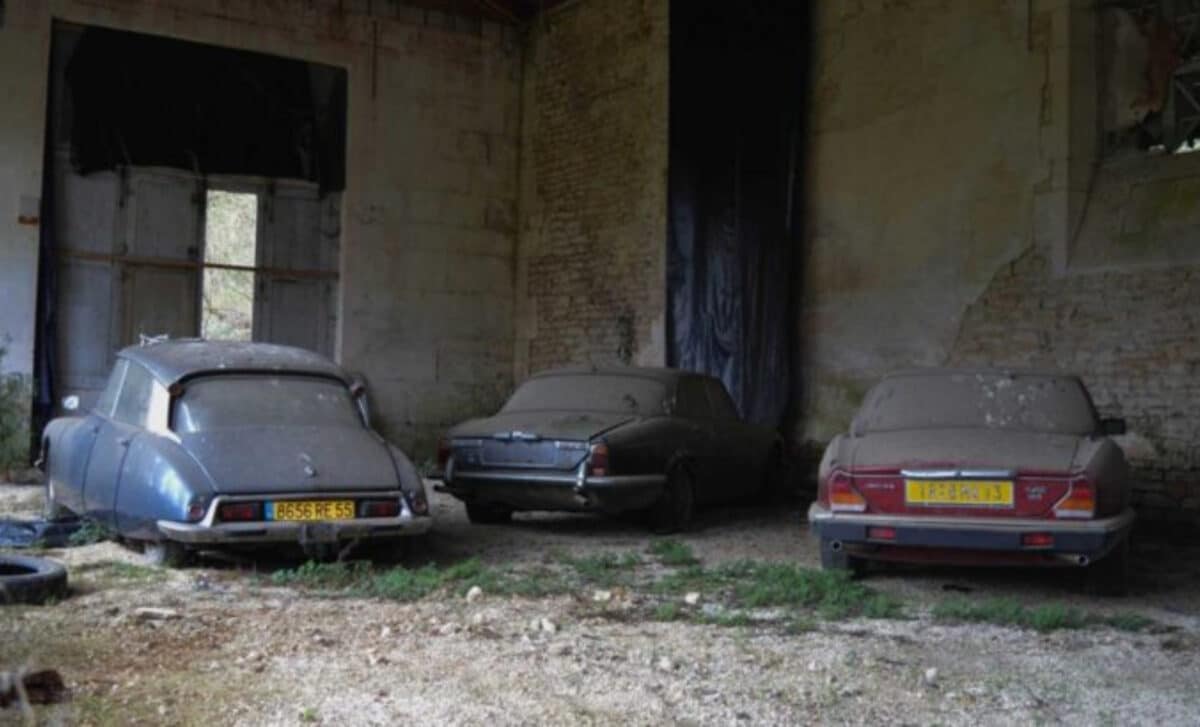
Two Jaguar Xj and a Distinctive Citroën Dsuper
Further along the lineup, the collection shifts back in time and rises in prestige. Two first-generation Jaguar XJ sedans are present: a Series II produced between 1973 and 1979, and a Series III built from 1979 to 1992. The latter can be identified by its large black bumpers, introduced from 1979 onward to standardize European models with their American equivalents.
Beside the British sedans is a Citroën DS, more precisely a DSuper. Until 1970, this version was known as the “ID 20.” It represents a simplified variant of the French model, lacking the hydraulic braking system and the signature mushroom-shaped brake pedal associated with the DS. Visually, it stands apart thanks to its silver chevrons at the rear, unlike the gold chevrons fitted to the standard DS.
The Lamborghini Espada, Jewel of the Barn
The highlight of the discovery, emphasized by No Man’s Land – Urbex, is a Lamborghini Espada. Launched in 1968, the Espada holds a unique place in the brand’s history as the only Lamborghini of its time to offer four seats, making it a distant predecessor to the Urus in terms of layout.
Its design was penned by Italian designer Marcello Gandini. Under the hood lies a 3.9-liter V12 engine developed in-house, producing between 325 and 350 horsepower depending on the version. Lamborghini claimed a top speed of 250 km/h when the model was new.
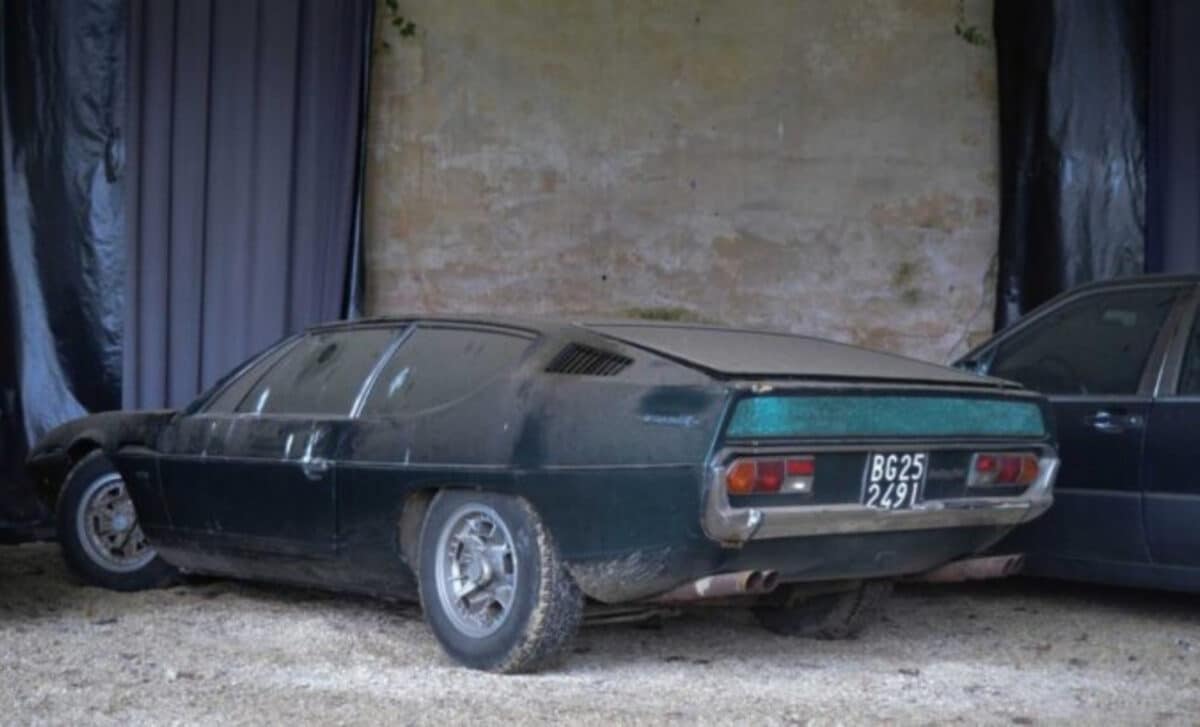
The Espada appears to be in excellent condition overall. One detail stands out: its steering wheel has been stolen. Without it, the grand tourer’s promised performance will remain theoretical.
Six cars, decades of automotive heritage, and a barn open to the elements, an unlikely tableau discovered by chance during a simple walk in the woods.