
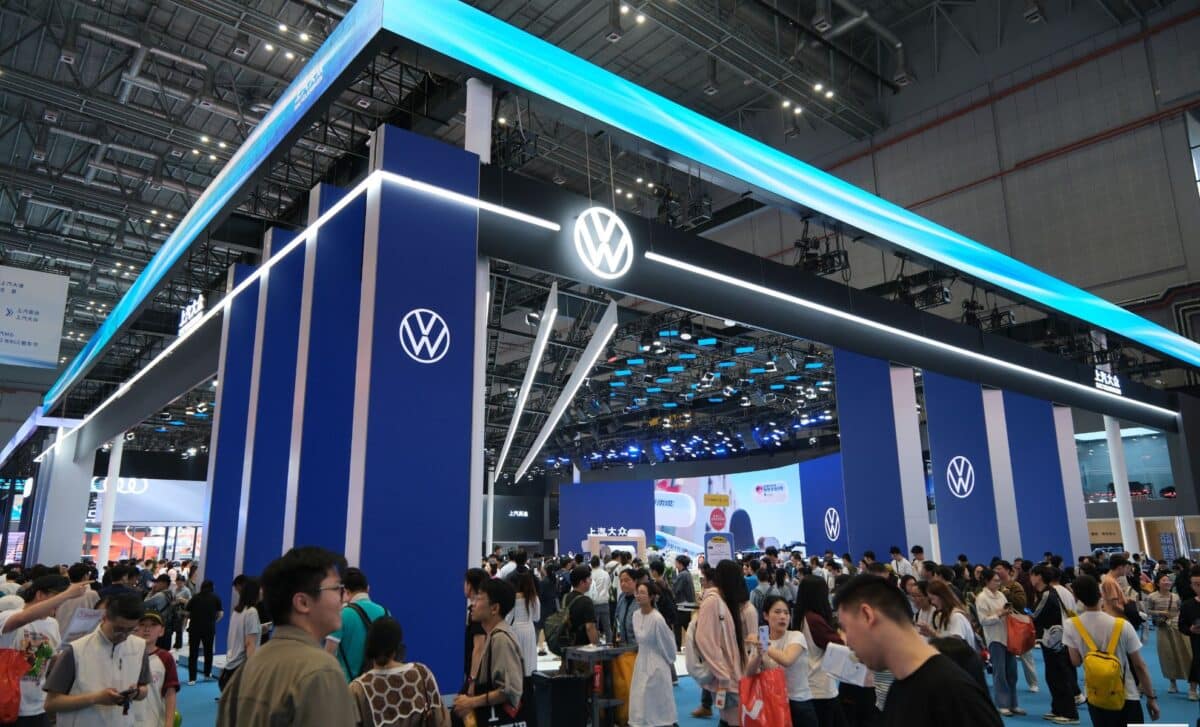
Volkswagen is facing mounting pressure from Chinese brands that are advancing quickly in electrification, digital features, pricing, and development speed. At an event in Beijing ahead of the country’s annual auto show, the company outlined a strategy centered on localized innovation and new intelligent vehicle capabilities.
The German automaker says its approach reflects a shift toward a China-specific development model. Its “In China, for China” strategy aims to expand local research and development, accelerate timelines, and deepen partnerships with domestic technology firms.
Ai Agents Designed For Complex In-car Interactions
Volkswagen announced that its new China-only electronic architecture will support onboard AI agents capable of handling more advanced tasks than traditional voice assistants. According to Reuters, the company said these systems are intended to enable “highly intuitive, human-like interaction” between driver and vehicle while maintaining robust personal data protection.
Unlike standard voice systems that respond to simple queries, the AI agents are designed to manage more complex decision-making processes. This marks a shift toward deeper integration of artificial intelligence into the driving experience, with a focus on usability and automation within the vehicle environment.
Real-world Functions Extend Beyond Navigation
The practical applications outlined by Volkswagen highlight how these AI agents could operate in daily scenarios. Ralf Brandstaetter, the company’s top executive in China, explained that the system could search for the highest-rated restaurant in a given area, make and confirm a reservation, and then guide the driver to the destination.
The technology could also organize parking upon arrival, illustrating a level of end-to-end task management not typically associated with in-car systems. These capabilities are presented as part of a broader effort to deliver a more seamless and autonomous user experience.
A Broader Push To Regain Competitiveness In China
Volkswagen’s AI rollout is tied to a larger strategic repositioning in China, where it aims to move beyond its image as a traditional internal combustion-focused manufacturer. The company has described its plan as its largest electric mobility offensive in the country.
Volkswagen intends to launch more than 20 new electrified vehicles, contributing to a total of 50 new models in China by 2030. CEO Oliver Blume said the combination of new models and technology initiatives sends a clear signal that “we are back.”
The initiative also relies on local collaboration. Standing alongside Blume at the Beijing event, Yu Kai, CEO of Horizon Robotics, said the jointly developed agentic AI would help extend advanced technology beyond premium vehicles into the mass market.