
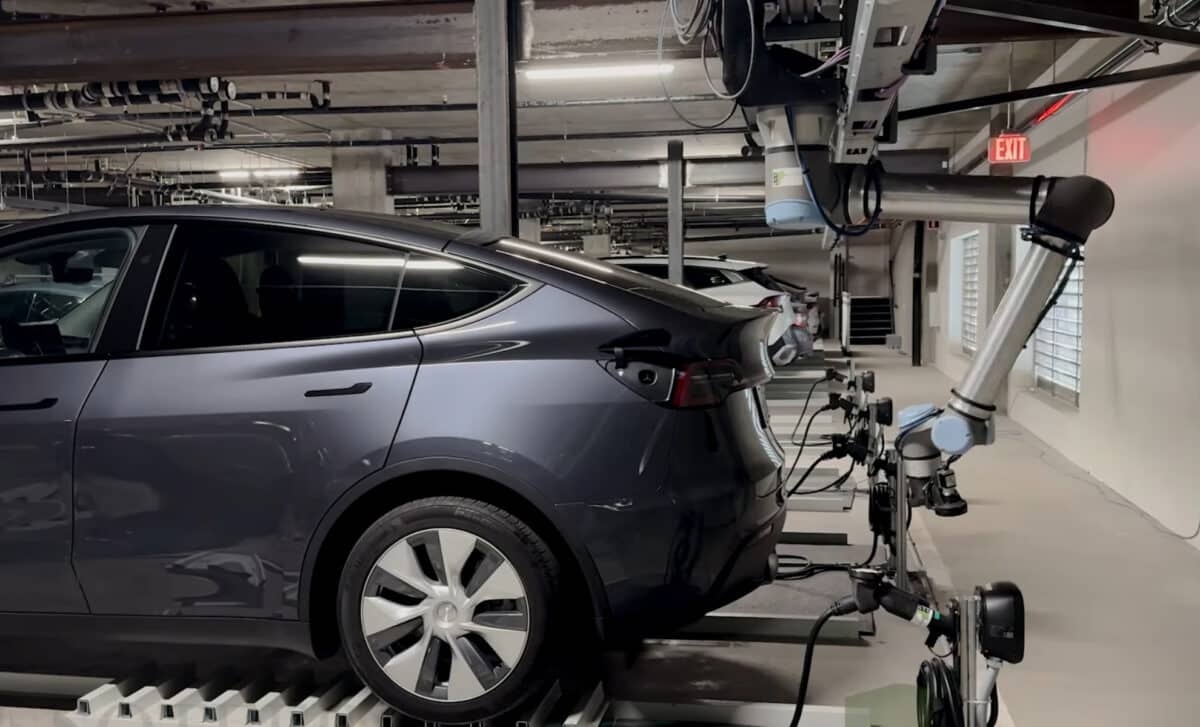
In Menlo Park, California, residents of a new apartment complex can leave their cars at the entrance of a garage and walk away. The system parks the vehicle, and if it is electric, can also charge it using a robotic arm, without any human involvement.
The automated garage serves the Lume apartment complex, a residential development that opened in late 2024. While plugging in an EV usually takes less than a minute, this project addresses a specific challenge: in a fully automated parking structure, there is no access for drivers to manually connect a charging cable.
About a decade ago, Tesla introduced the idea of a robotic arm that would automatically plug in an electric vehicle for overnight charging. That product never reached the market. Other companies have since stepped in with complete systems that bring automated charging into real-world applications, including residential buildings.
A Parking Solution Shaped by Strict Building Constraints
The Lume Menlo Park development is located in a FEMA flood zone, which prohibited the construction of below-grade parking. At the same time, local zoning height restrictions limited how much vertical space could be used for traditional parking structures.
Faced with those constraints, developers opted for a high-density, three-level automated parking system. According to Greystar, the real estate company that operates the complex, the structure provides more than 450 parking spaces and is the first of its kind for an apartment community in the United States, as reported by InsideEVs.
The garage itself was completed last year, after the residential complex opened. The two buildings include a total of 441 multi-family units. Amenities at the property include co-working spaces, a pool, and a yoga studio. Located in Silicon Valley, the complex reflects the region’s pricing standards, with the lowest monthly lease found starting at around $3,300.
how the automated parking and charging system works
Drivers enter the garage and leave their vehicle at the designated drop-off point. From there, the automated system transports the car to the first available parking space.
Electric vehicle owners can request a charging session using a smartphone app. If a charging bay is available, the system automatically moves the vehicle from its parking spot to the charging area. A robotic arm then connects a Level 2 charging cable to the car.
When the battery reaches the requested state of charge, the system unplugs the vehicle and transfers it back to a regular parking space. The charging bay is then made available for another EV that needs a top-up. The entire sequence, from parking to plugging in and unplugging, takes place without human intervention.
The Companies Behind the Project
The automated parking system was developed by Switzerland-based Sofetin and installed by Parkworks, a California company. The overall housing project was designed by Heller Manus Architects, while the parking garage was designed by Watry Design.
The result is a fully integrated residential system where parking and charging are handled robotically. In a setting where manual access to vehicles is not possible, the robotic charging arm becomes less of a novelty and more of a practical solution embedded into everyday apartment living.