
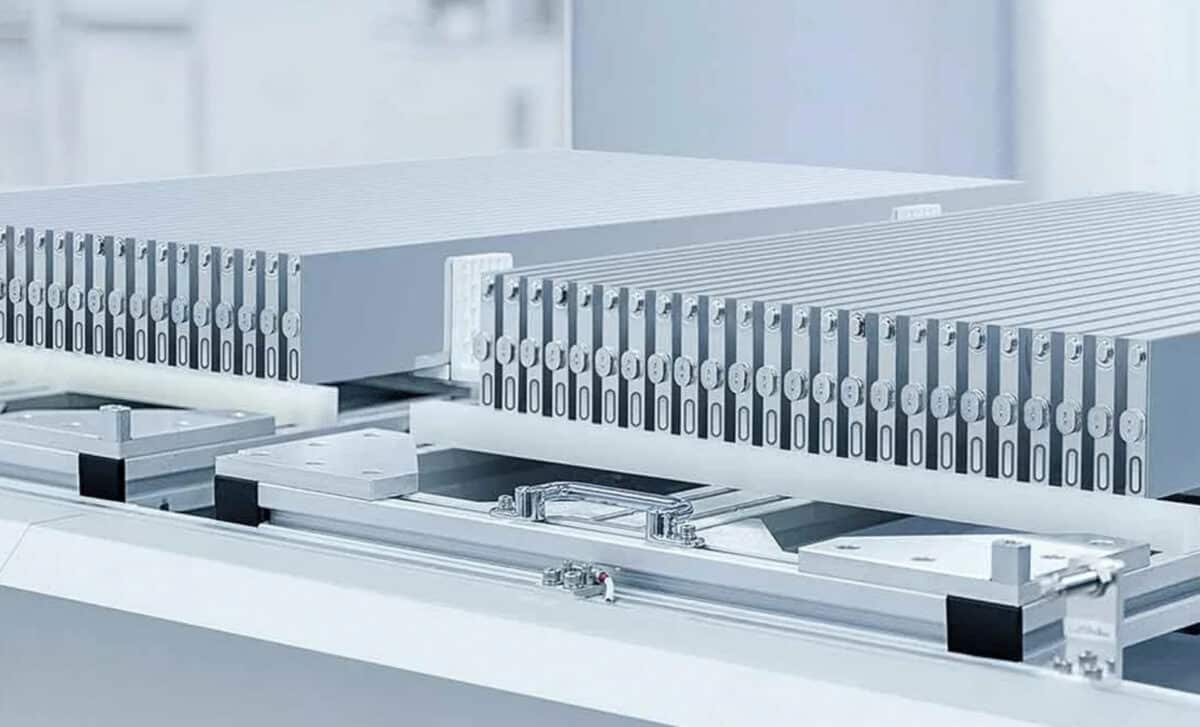
The momentum is particularly visible in China, where leading manufacturers are accelerating trials and outlining production timelines. Companies such as BYD and CATL, together representing more than 55% of global EV battery sales, are preparing for limited production as early as 2027.
At the same time, global competitors are advancing their own programs. From the United States to Europe and Asia, the push toward solid-state batteries reflects a broader effort to improve energy density, charging speed, and safety without fundamentally changing how electric vehicles are used.
Early Vehicle Tests Reveal Significant Gains in Range and Energy Density
Chinese automakers have begun testing solid-state batteries under real conditions, sharing detailed performance figures. Dongfeng Motors, for instance, recently conducted extreme cold tests on a prototype battery rated at 350 Wh/kg, achieving a range of over 1,000 km (620 miles) under CLTC standards, according to Electrek.
Changan Automobile reported higher figures with its “Golden Bell” all-solid-state battery. With an energy density of 400 Wh/kg, the company claims it can deliver more than 1,500 km (932 miles) of driving range. Trial installations are expected before the end of the third quarter of 2026.
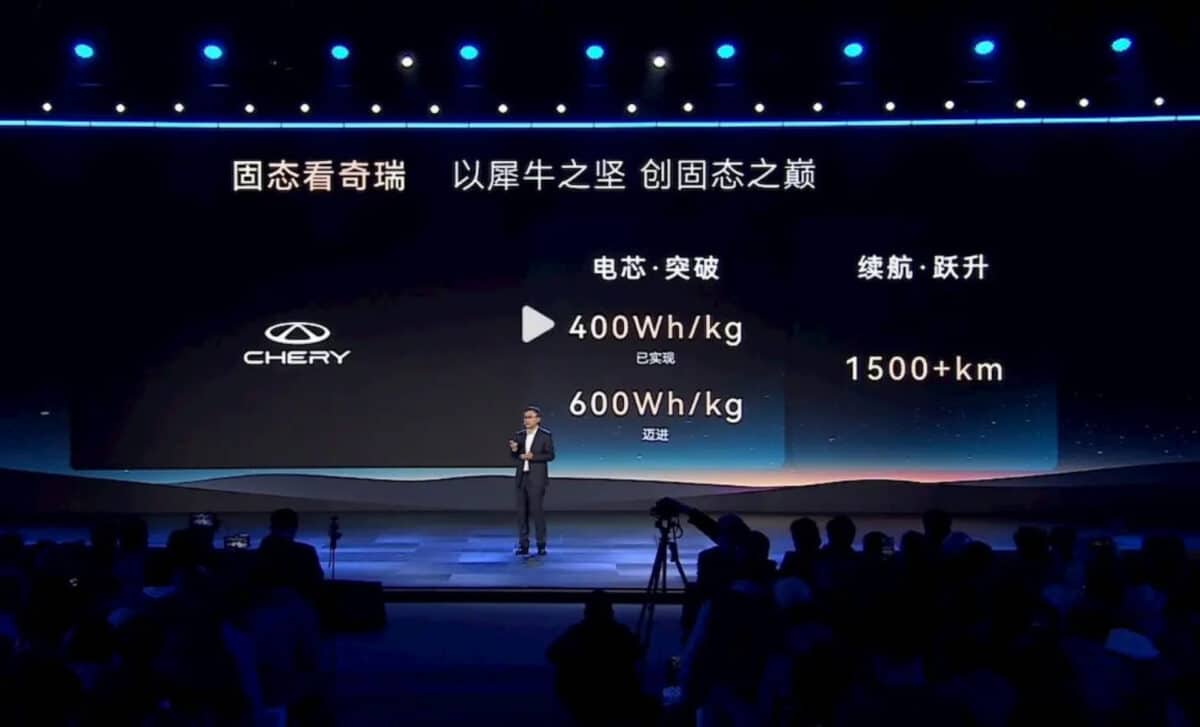
Chery presented its own developments during a “Battery Night” event, unveiling a 600 Wh/kg all-solid-state battery within its “Rhino” series. The company stated that this version can also exceed 1,500 km (932 miles) of range and plans to begin vehicle testing next year with the Exeed ES8.
Semi-Solid Solutions and Ultra-Fast Charging Expand the Transition Phase
Alongside fully solid-state designs, hybrid approaches are emerging. Chery’s Rhino lineup includes a 400 Wh/kg solid-state “S-Series” battery and a semi-solid-state “E liquid” version, illustrating a gradual transition toward fully solid architectures.
The semi-solid battery is scheduled to debut in the Exeed EX7 later this year, while the S-Series will equip the Exeed ES sedan. According to Chery, the Rhino E liquid battery can support charging power of up to 1,200 kW, adding 500 km (310 miles) of range in just eight minutes.
Charging infrastructure is evolving at a similar pace. BYD recently introduced its Blade Battery 2.0 along with new charging systems capable of delivering 1,500 kW. These systems allow vehicles to charge from 10% to 70% in five minutes, or up to 97% in nine minutes. The Blade Battery 2.0 itself can provide over 1,000 km (621 miles) of range under CLTC conditions.
Global Race Accelerates as Commercialization Targets 2027
Competition around solid-state batteries is intensifying beyond China. Mercedes-Benz recently tested a modified EQS equipped with solid-state cells from U.S.-based Factorial Energy, reaching more than 1,200 km (745 miles) on a single charge.
Factorial Energy has also launched its first commercial program in partnership with Karma Automotive. In remarks reported by The New York Times, CEO Siyu Huang indicated that solid-state batteries could begin appearing in production vehicles as early as 2027.
The company’s Solstice platform is designed to reach up to 450 Wh/kg, representing an increase of about 80% compared to conventional lithium-ion batteries. Factorial states this could enable over 600 miles of driving range.
Partnerships with major automakers, including Mercedes-Benz, Stellantis, Hyundai, and Kia, underline the scale of ongoing development. While the ranges being tested often exceed everyday driving needs, the data points to a broader transformation in battery performance and deployment timelines.