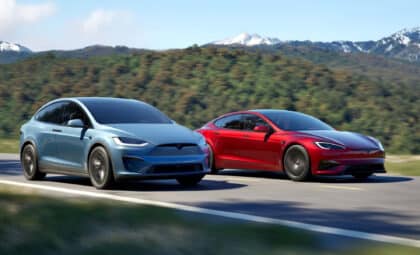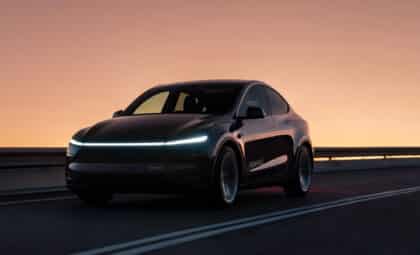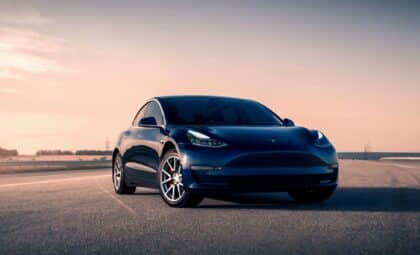

The change reflects a broader shift in trade policy that is once again reshaping Tesla’s supply chain in North America. After months of elevated prices caused by tariffs on US-made vehicles, the company appears to be preparing to supply Canada with Model 3 vehicles produced in China.
Over the past two years, Tesla’s strategy for supplying Canada has repeatedly changed as trade tensions between the United States, Canada and China triggered new tariffs and counter-tariffs. Each policy shift has altered where the company sources vehicles for the Canadian market.
Tesla previously delivered Chinese-built Model 3 vehicles from its Gigafactory Shanghai to Canada alongside cars produced in the United States. That approach came to an end in late 2024 when Canada imposed a 100% tariff on Chinese electric vehicles, effectively cutting off that supply route.
Tariffs Pushed the Model 3 Price Sharply Higher
After Chinese-built vehicles were blocked by tariffs, Tesla began supplying Canada exclusively with Model 3 vehicles produced at its Fremont, California factory.
That arrangement quickly became problematic. In early 2025, Canada introduced 25% counter-tariffs on US-made vehicles as part of its response to American trade measures. The additional duties sharply increased the price of Tesla’s sedan in the Canadian market.
According to Electrek, the Model 3 Long Range All-Wheel Drive rose to $79,990 CAD. The tariffs embedded in the price represented roughly $25,000 to $30,000 per vehicle. Demand fell as prices climbed, leaving many vehicles unsold.
Tesla adopted a different strategy for the Model Y. Instead of importing the SUV from the United States, the company sourced it from Gigafactory Berlin in Germany, allowing it to avoid tariffs linked to US-built vehicles. The Model 3 did not have a similar alternative, since the car is not manufactured in Europe.
Canada Opens Limited Access to Chinese-Built EVs
Canada changed course in early 2026 by introducing a new import program for electric vehicles manufactured in China. The agreement followed what Prime Minister Mark Carney described as a strategic partnership with China.
The new policy reduces the tariff on Chinese EVs to 6.1%, replacing the previous 100% surtax. The program also introduces an annual quota allowing 49,000 Chinese-built electric vehicles to enter the Canadian market.
Half of that allocation, 24,500 vehicles, is available during the first six months of the program beginning on March 1. Canada’s Border Services Agency officially repealed the earlier surtax on that date, and import permits are now available.
Soon after the policy came into effect, Tesla’s Canadian website showed no Model 3 inventory available. Sources familiar with the situation told Electrek that the remaining US-built vehicles were shipped back to the United States, where they can be sold without the tariffs applied in Canada.
Tesla Already Certified to Import Shanghai-Built Vehicles
Tesla may benefit from an early advantage in the new import system because its Chinese-built vehicles already meet Canadian certification requirements. Both the Shanghai-built Model 3 and Model Y appear in Transport Canada’s certification database. This means the vehicles can be imported immediately once permits are secured.
Other manufacturers are still waiting for approvals. Chinese automaker BYD, for example, is expected to need about eight weeks to complete the certification process before its vehicles can enter the Canadian market.
Industry estimates suggest Tesla could obtain between 7,000 and 10,000 of the first 24,500 import permits available in the initial phase of the program. That would represent roughly 29% to 41% of the first-half allocation.
The quota is expected to expand in the coming years, reaching 70,000 vehicles annually by 2030. For the moment, the policy change allows Tesla to once again rely on its Shanghai factory to supply the Canadian market, after a period in which tariffs pushed Model 3 prices to nearly $80,000 CAD.