
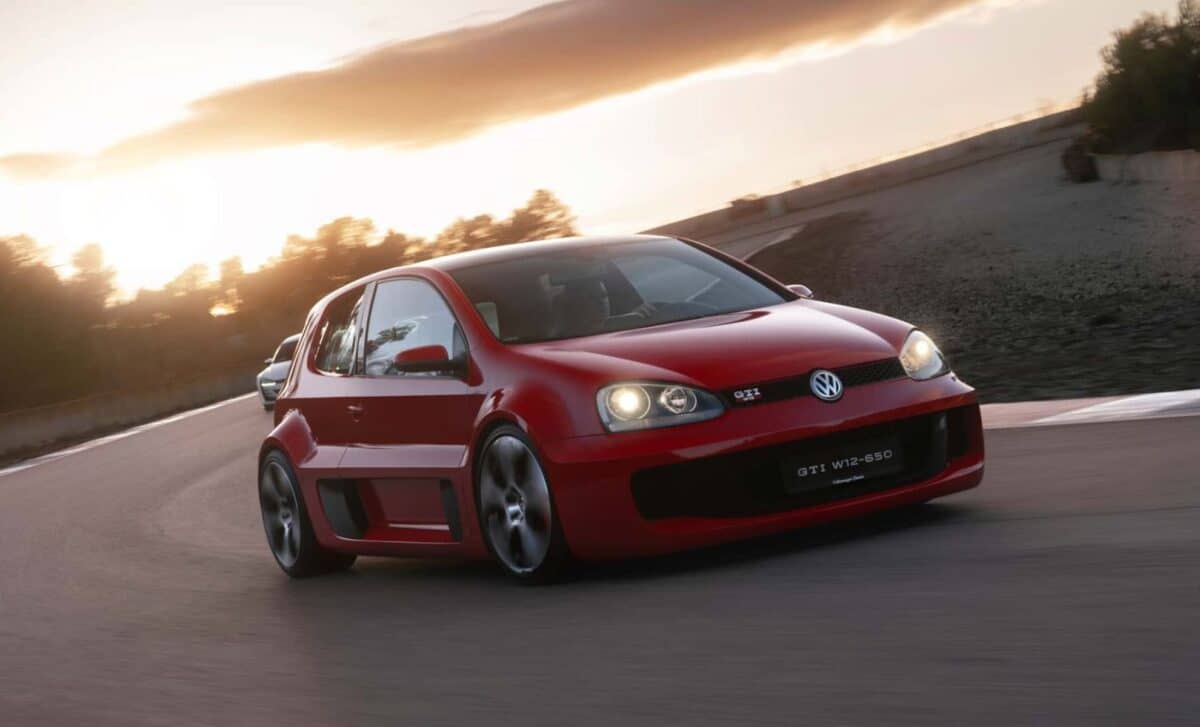
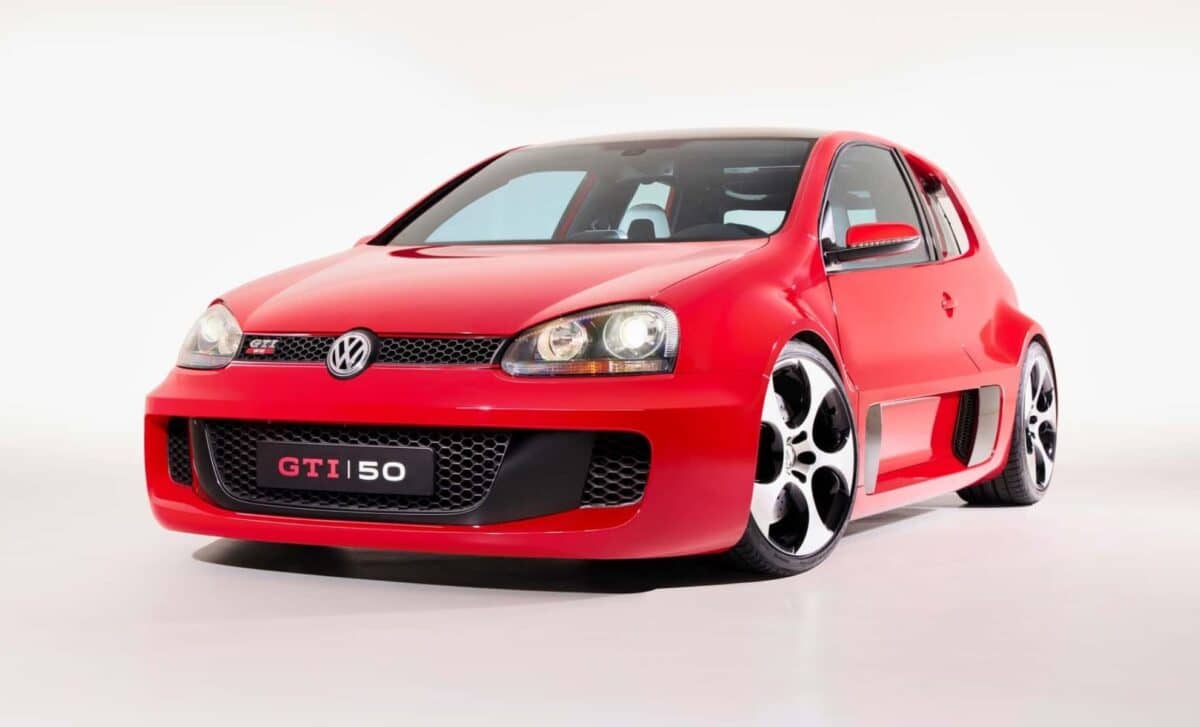
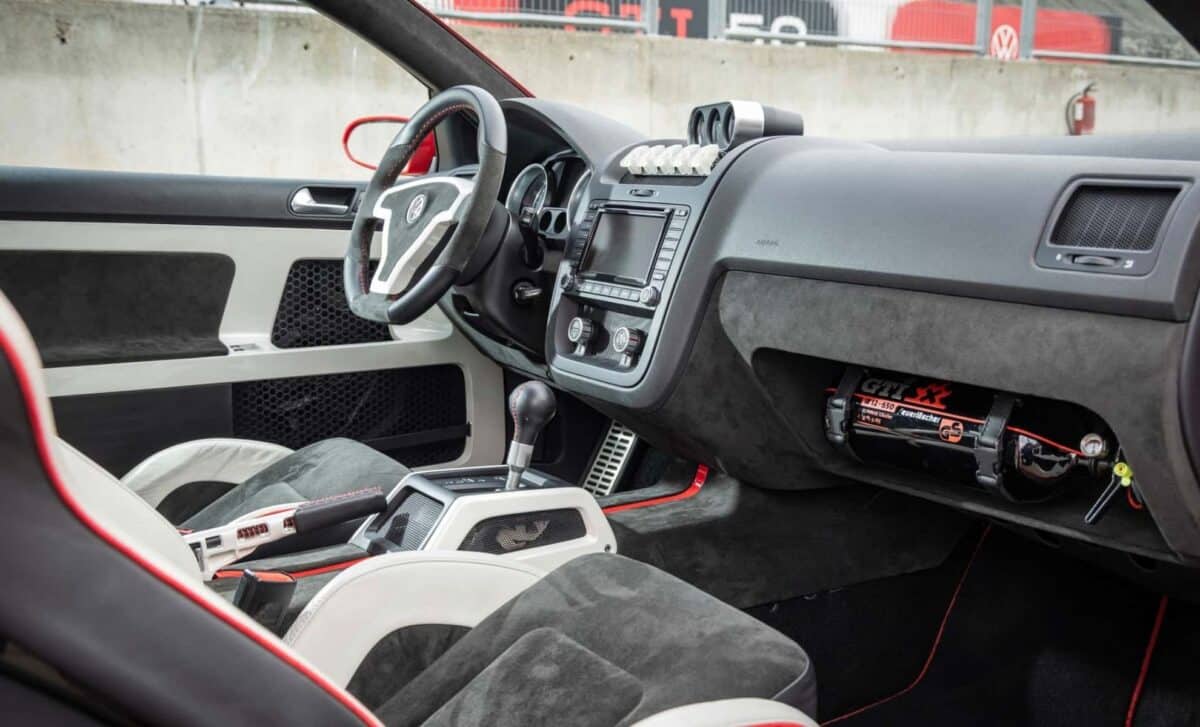
Now repainted in Tornado Red, the mid-engined concept resurfaces as part of the GTI’s milestone celebration, standing apart from the current limited-run Edition 50 by showcasing a level of engineering excess no production Golf has approached.
The GTI turns 50 this year, and Volkswagen is promoting the street-legal Edition 50 as the ultimate evolution of the badge. Yet, the wildest interpretation of the Golf formula arrived back in 2007, when engineers in Wolfsburg created a one-off machine that reconfigured the compact hatch into something closer to a supercar.
That car, known as the Golf GTI W12-650, was described as a “hybrid,” though not in the electrified sense. Instead, it blended components from across the Volkswagen Group portfolio, combining parts from Bentley, Audi, Lamborghini, and Volkswagen itself into a single, highly unconventional package.
A Bentley-Sourced W12 Mounted Behind the Seats
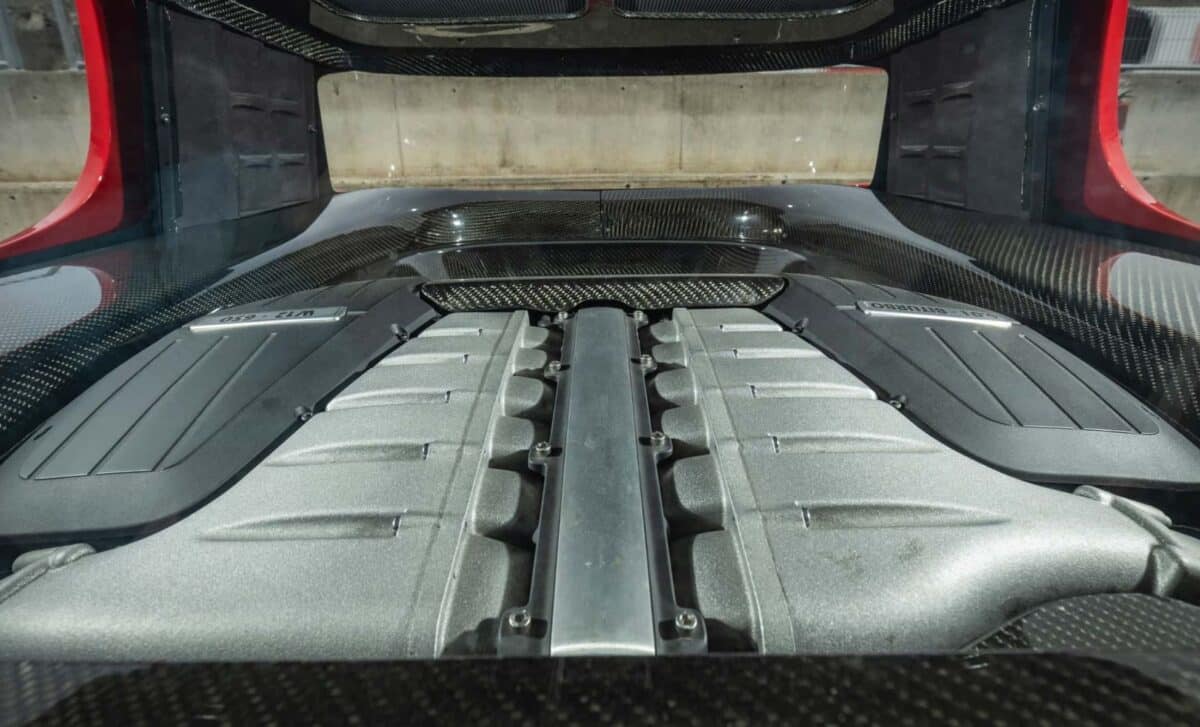
At the heart of the concept sits a 6.0-liter twin-turbo W12 engine borrowed from a Bentley Continental GT. Mounted behind the seats in a mid-engine configuration, the unit produces 640 horsepower and 553 pound-feet (750 Newton-meters) of torque. Power is sent exclusively to the rear wheels through a six-speed automatic transmission sourced from the Volkswagen Phaeton, a model that ultimately failed to find commercial success.
The unusual engine layout required substantial structural modifications. According to Motor1, engineers widened the three-door Mk5 Golf body by 6.3 inches (160 millimeters) to accommodate the drivetrain and additional hardware. The concept merged two narrow-angle V6 engines to form the W12 configuration, transforming the traditionally front-engine hatchback into a mid-engined, rear-wheel-drive machine.
@volkswagen 650 PS. W12 twin-turbo. 0–100 km/h in 3.7 s. 325 km/h. In 2007, we created the ultimate expression of performance: the Volkswagen Golf GTI W12-650. One GTI. One engine no one expected. One icon. #Volkswagen #GTI50 #golf #GTI #IconsOfGTI ♬ Originalton – volkswagen
Performance figures reflected that transformation. The W12-650 accelerated from 0 to 62 mph (100 km/h) in 3.7 seconds. Even 19 years later, that time remains nearly a second quicker than the current-generation Golf R with all-wheel drive. Flat out, the concept was said to reach 325 km/h (201.8 mph), though that top speed was never officially tested.
A Parts-Bin Experiment with Supercar Hardware
The “hybrid” nature of the project extended well beyond its engine. Motor1 reports that the concept used front brakes from an Audi RS4, while the rear axle and rear brakes were sourced from the Lamborghini Gallardo. The result was effectively a Golf assembled from high-performance components across the group’s portfolio.
Aerodynamic and cooling changes were equally dramatic. The car featured a carbon-fiber roof with an integrated cooling scoop designed to channel air toward the rear-mounted radiators. Side-mounted cooling vents were added, though they never reached production on any Golf variant. The C-pillar was reshaped to improve airflow to the twelve-cylinder engine.
A quad exhaust system, typically associated with the flagship Golf R, was installed at the rear. The 19-inch wheels retained a familiar design, though they were paired with wide 295-section tires intended to manage the engine’s output. With 553 pound-feet delivered solely to the rear wheels, the car was regarded as difficult to drive, described as one of the most temperamental hot hatches ever conceived.
A Symbol of Ferdinand Piech’s Ambitious Era
The GTI W12-650 emerged during a period defined by the ambitions of Ferdinand Piech, the late Volkswagen Group chairman known for pushing the company toward technically ambitious projects. The concept reflected Piech’s determination to build the unthinkable, culminating in landmark vehicles such as the Bugatti Veyron.
Not every project from that era succeeded commercially. The Phaeton and Audi A2 were cited as sales disappointments. Even so, Piech remains one of the most influential figures in automotive history, and the W12-powered Golf stands as a reminder of a time when the Volkswagen Group pursued spectacular engineering exercises with few apparent constraints.