
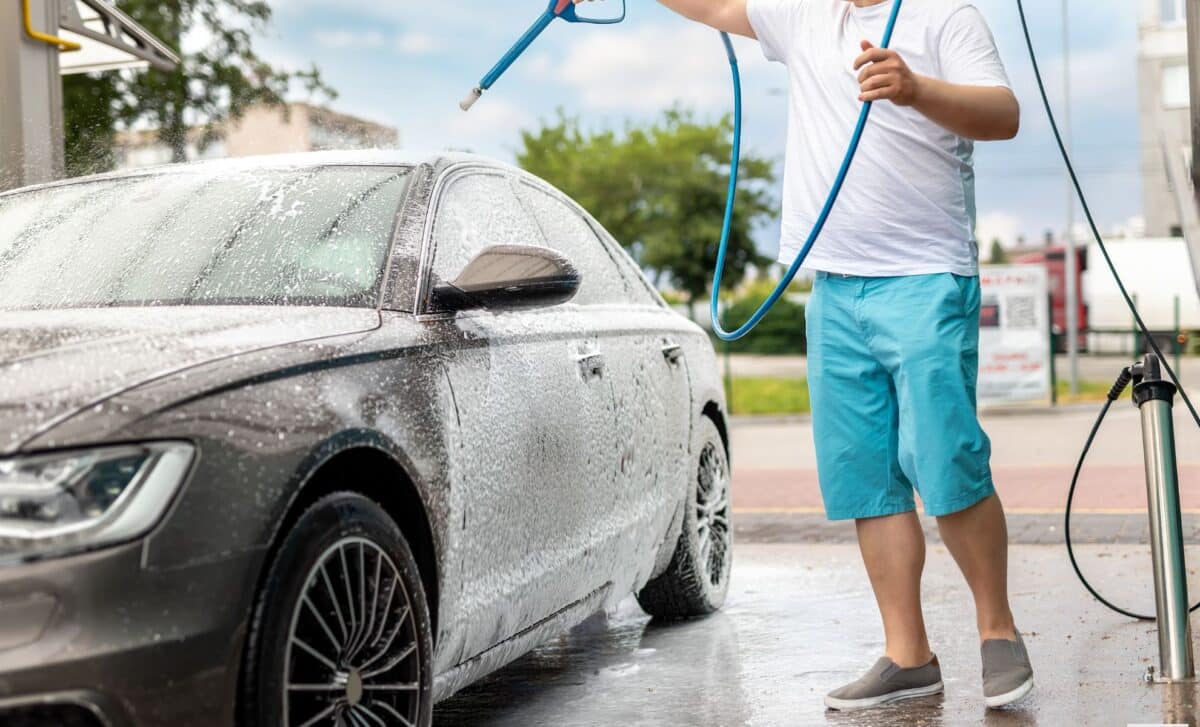
Many drivers wash their vehicles for aesthetic reasons, enjoying the look and feel of a freshly cleaned car. Beyond appearance, a clean vehicle can also contribute to a more pleasant driving experience for both drivers and passengers.
The idea that dirty cars might be more aerodynamic has circulated for years, largely because of comparisons with the dimpled surface of golf balls. Experiments conducted by MythBusters sought to determine whether this belief held any truth by measuring the fuel economy of the same vehicle under different surface conditions.
MythBusters Found A Clean Car Used Less Fuel
According to Jalopnik, MythBusters hosts Adam Savage and Jamie Hyneman tested an older sedan that appeared to be a fourth-generation Ford Taurus. The vehicle was first covered in dirt and mud and then driven on an empty track to measure fuel consumption.
During this initial run, the sedan achieved 24 miles per gallon. The team then thoroughly cleaned the vehicle and repeated the test on the same track. This time, the car returned 26 miles per gallon.
While the difference amounted to only 2 mpg, it is noticed that, with average gasoline prices near $4.30 per gallon, the cleaner vehicle would have saved approximately 38 gallons of fuel over 10,000 miles. That equates to roughly $163.40 in fuel savings.
The Golf Ball Theory Produced Surprising Results
The belief that dirt could improve efficiency stems from the design of golf balls. Their dimpled surfaces allow them to travel much farther through the air than smooth golf balls.
After comparing a dirty car with a clean one, the MythBusters team conducted a second experiment. They covered the Taurus in clay and tested two configurations: one with a smooth clay surface and another with dimples pressed into the clay to mimic a golf ball.
The smooth clay-covered car achieved 26 mpg, matching the result obtained by the clean vehicle in the earlier test. The dimpled version, meanwhile, recorded 29 mpg. The difference between the smooth and dimpled surfaces was 3 mpg.
The explains is that cars are not designed with golf-ball-like surfaces because vehicles operate at higher speeds than golf balls. Studies cited in the report indicate that the aerodynamic benefits of dimples decrease as speed increases. The same report notes that researchers from the Massachusetts Institute of Technology explored “morphable surfaces” capable of switching between smooth and dimpled configurations in 2014.

Airlines Also Benefit From Cleaner Surfaces
The relationship between cleanliness and efficiency extends beyond automobiles. Airlines also seek aerodynamic gains by maintaining clean aircraft exteriors.
A clean airplane can save around 0.5% in fuel consumption, equivalent to about half a ton of jet fuel. Keeping aircraft clean is particularly relevant for planes operating in harsh weather conditions, where dirt accumulates more easily on exterior surfaces.
With jet fuel priced at approximately $141.64 per barrel, even modest efficiency gains can translate into meaningful savings for airline operators. Aircraft cleaning can cost anywhere from $350 for a basic wash to $10,000 for a full exterior treatment.
For car owners, maintaining a clean vehicle requires far less expense. Experts recommend washing a vehicle with water, car shampoo, and clean microfiber towels about twice per month. It also advises avoiding automatic car washes equipped with abrasive brushes because of the potential risk of paint damage.