

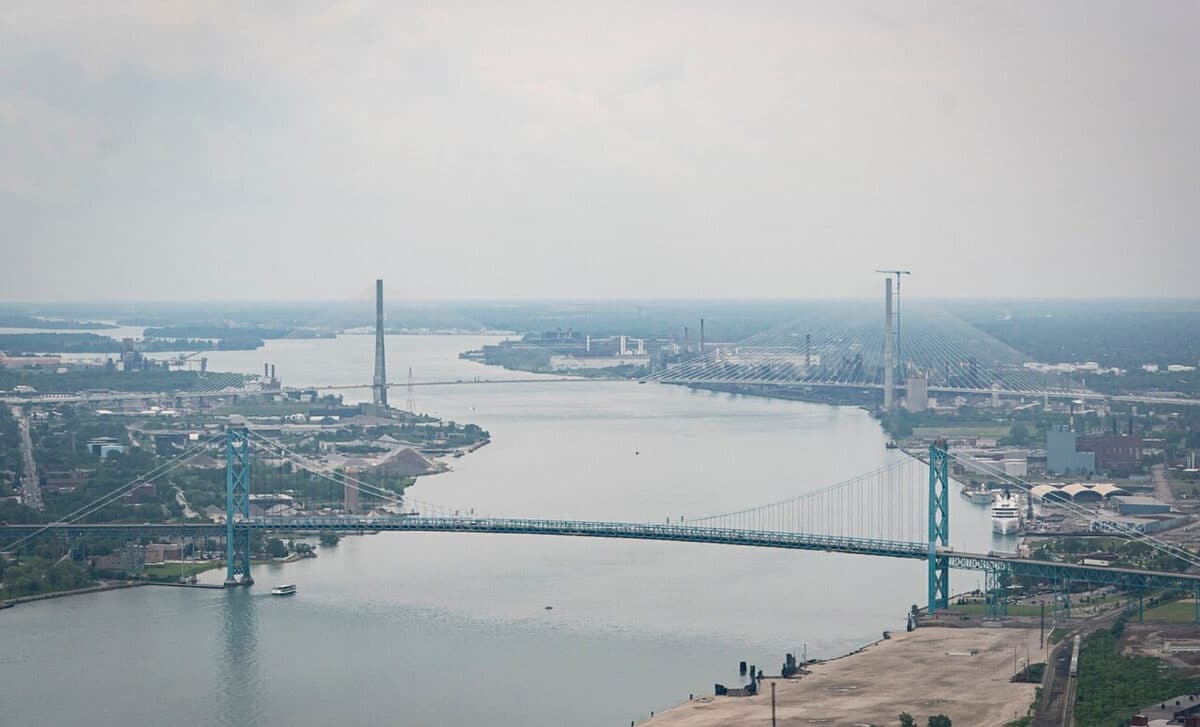
For decades, the automotive industry has relied on a highly integrated supply chain stretching across the U.S.-Canada border. Parts routinely cross between the two countries before a vehicle reaches final assembly, leaving manufacturers dependent on uninterrupted transportation links.
That dependence has placed renewed attention on the Detroit-Windsor corridor, where a single crossing handles a significant share of bilateral trade. The new Gordie Howe International Bridge was conceived as a way to reduce that vulnerability, though questions surrounding its opening have introduced fresh uncertainty.
A Strategic Route for Automotive Production
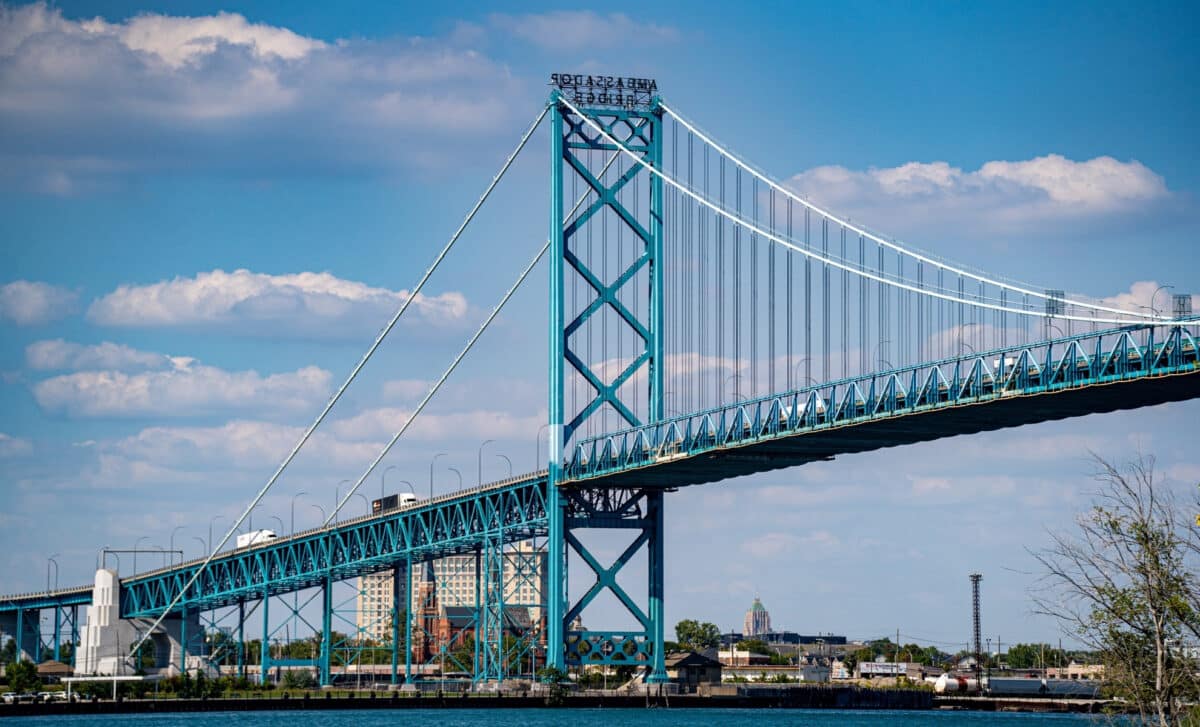
The existing Ambassador Bridge remains a critical gateway for manufacturers on both sides of the border. According to Autoblog, more than $300 million worth of goods moves across the four-lane bridge every day between Detroit and Windsor.
The automotive sector’s reliance on just-in-time logistics leaves little room for delays. Ford Motor Company has indicated that even a brief interruption at the border can result in a shortage of seats for its F-150 pickup within an hour, demonstrating how quickly production schedules can be affected.
To address these constraints, the Gordie Howe International Bridge was designed as a six-lane crossing connecting Ontario’s Highway 401 directly to Michigan’s Interstate 75. The project is intended to provide an alternative to the existing crossing and reduce dependence on a single route.
The Lasting Impact of the 2022 Blockade
Industry concerns about supply chain resilience were reinforced during the 2022 trucking blockade that disrupted traffic in the Detroit-Windsor region.
Automotive leaders described the episode as a “Strait of Hormuz moment,” reflecting the extent to which the industry depends on uninterrupted movement through the corridor. The disruption was estimated to have cost the sector roughly $1 billion.
The event also highlighted the risks associated with relying on a single crossing. The Ambassador Bridge, described in the source as a century-old private crossing, remains a central link in North American manufacturing networks, making any interruption particularly significant for automakers and suppliers.

Political Tensions Add Uncertainty to the Project
While the bridge was designed to strengthen trade flows, its completion has become linked to wider political disputes. Donald Trump recently threatened to delay the bridge’s opening amid disagreements related to toll revenue and ownership.
The comments drew a response from Windsor Mayor Drew Dilkens, who said Canada should wait for a more favorable moment rather than agree to what he viewed as a poor trade deal.
These developments are unfolding against a backdrop of broader trade tensions. Manufacturers have absorbed billions of dollars in tariff penalties over the past year. The situation escalated when Ottawa imposed retaliatory import duties on American vehicles, a measure that altered cross-border trade patterns and increased assembly costs for factories.
Automakers are preparing for difficult market conditions. Experts cited in the report project a decline of 1.8 million vehicle sales in North America, while European manufacturers have frozen inventories at ports. Within this environment, the Detroit-Windsor corridor remains a focal point for an industry that depends on predictable and efficient cross-border transportation.