
The announcement comes as car manufacturers reassess their electric vehicle strategies amid shifting market conditions. Some companies have faced significant financial losses after investing heavily in dedicated EV platforms that were later reconsidered or delayed.
Manufacturers such as Honda, Afeela, and Stellantis have already experienced the financial risks tied to developing bespoke EV architectures, with projects sometimes being scaled back after substantial investment. In that context, solutions that allow flexibility between electric and hybrid systems are gaining attention.
Horse Powertrain, a joint venture between Renault and Geely, positions its new system as a way to adapt existing EV designs without requiring a complete redesign. The approach reflects a broader shift in the industry, where modularity and cost control are becoming priorities.
An All-in-One Unit Designed for Rear Axle Integration
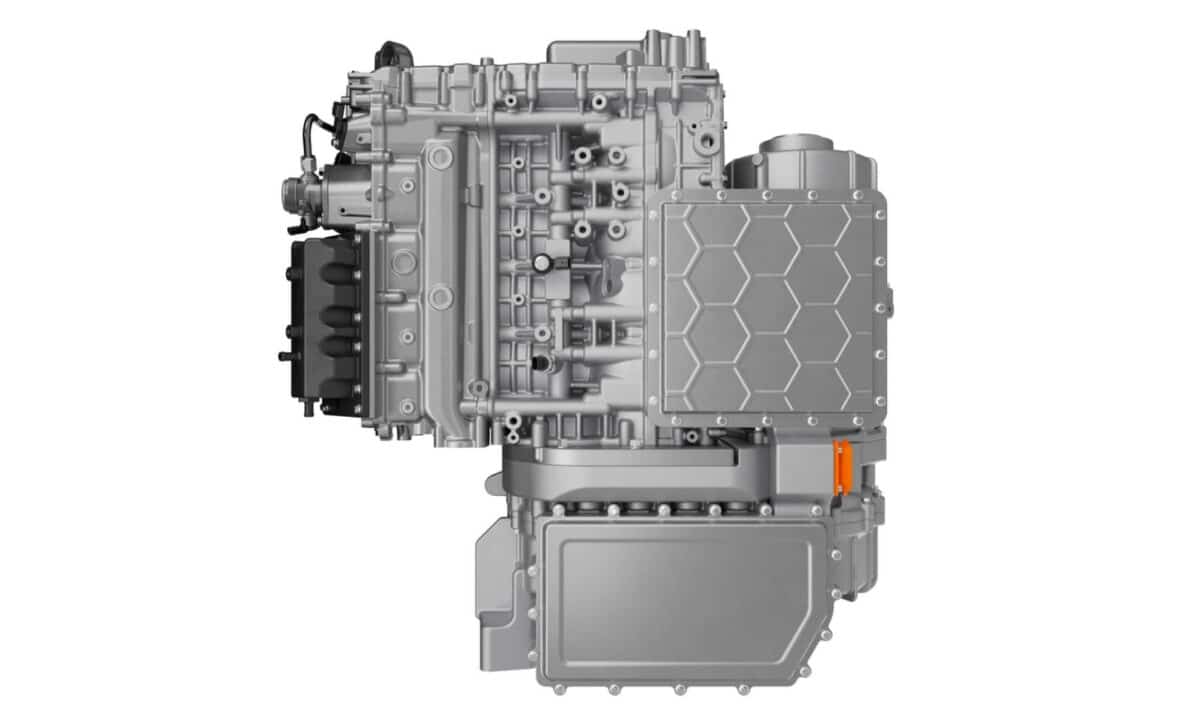
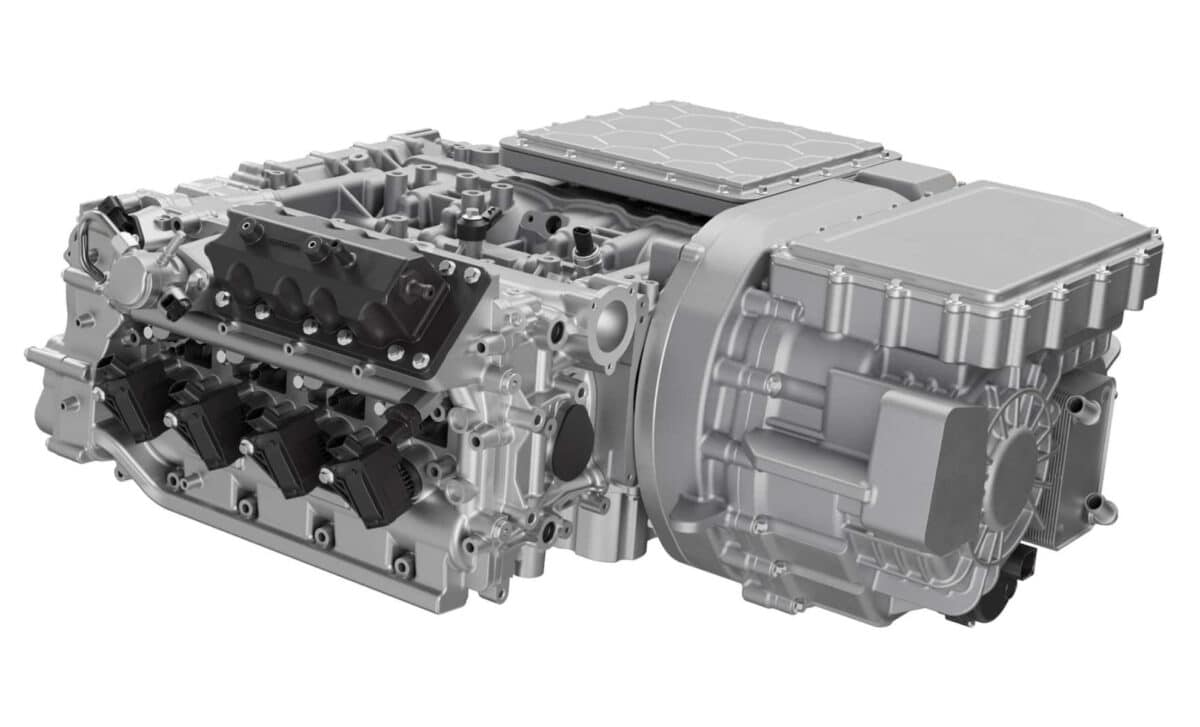
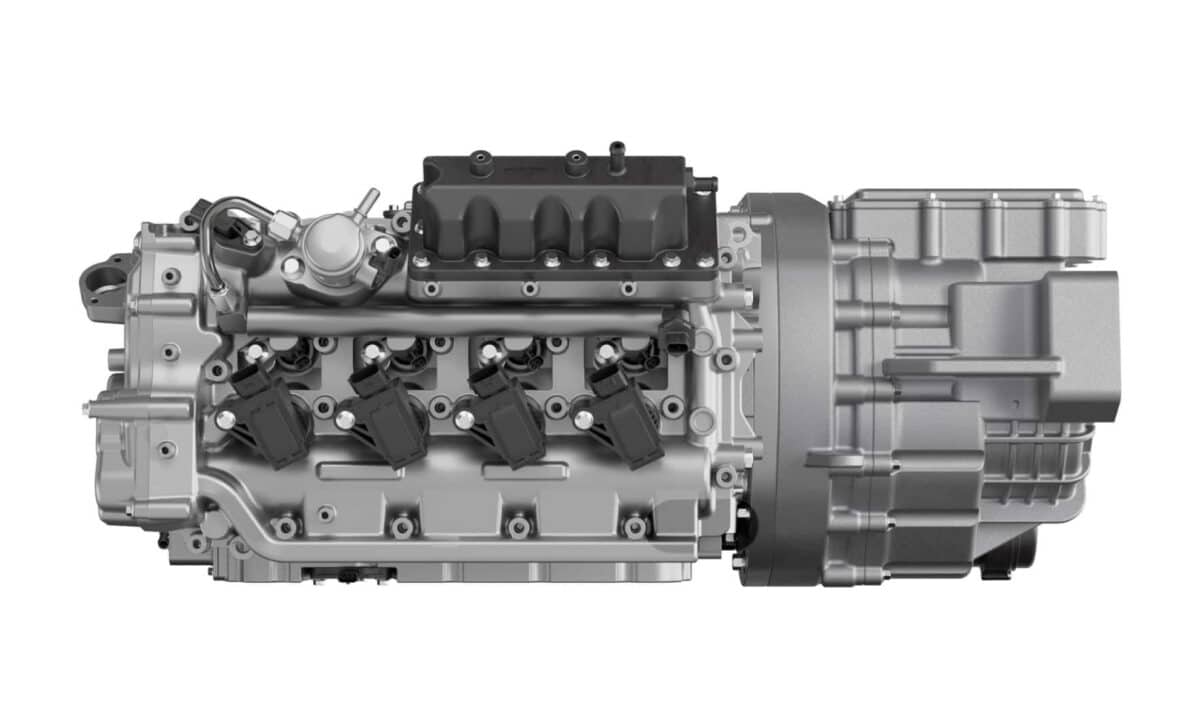
According to InsideEVs, the system, named X-Range C15 Direct Drive, integrates a four-cylinder gasoline engine, a transmission, and two electric motors within a single flat enclosure. The unit is designed to replace the rear electric motor of an existing EV platform.
This layout mirrors solutions seen in other projects, including Scout Motors’ Terra and Traveler extended-range electric vehicles, where a rear-mounted generator helps reduce noise and vibration. In the case of Horse Powertrain’s system, the rear placement also facilitates the integration of exhaust and after-treatment systems while preserving battery space under the cabin.
The design allows automakers to incorporate hybrid functionality into vehicles that were originally conceived as fully electric, limiting structural modifications and associated costs.
Dual-Motor Configuration and Engine Options
The X-Range C15 Direct Drive uses a P1+P3 electric motor configuration. A smaller motor is connected to the engine’s crankshaft, while a larger motor is positioned at the transmission’s output shaft.
The gasoline engine is a 1.5-liter unit available in two variants: a naturally aspirated version producing 94 horsepower (70 kilowatts) and a turbocharged version delivering 161 horsepower (120 kilowatts). The P1 motor primarily functions as a generator for the high-voltage battery in both series and parallel modes.
With the naturally aspirated engine, the system can supply up to 70 kilowatts to the battery, while the turbocharged version increases that figure to 110 kilowatts. The P3 motor, meanwhile, provides traction to the rear wheels, either independently or in combination with the internal combustion engine.
Flexible Integration and Extended Hybrid Capabilities
The system can also be adapted for all-wheel-drive configurations by pairing the rear unit with an additional electric motor on the front axle. This flexibility allows manufacturers to offer different drivetrain layouts without redesigning the entire platform.
The C15 Direct Drive includes built-in power electronics required for hybrid operation. It can also be combined with supplementary components such as a DC-to-DC converter, an onboard charger for plug-in hybrid and extended-range electric vehicles, and an 800-volt charging booster.
Horse Powertrain presents the system as part of a broader portfolio of hybridization solutions. It follows earlier products like the F15, designed for front axle integration, and the C15, a compact engine-generator unit intended to act as a range extender.
The development reflects ongoing adjustments within the automotive industry, as manufacturers seek to balance electrification goals with cost constraints and evolving market demand.