
Ganfeng, the Chinese company, which accounts for roughly 45% of the global lithium metal market and about 70% in China, already supplies key battery materials to Tesla, Volkswagen, Hyundai, BMW, and several leading Chinese automakers. Ganfeng recently signed a four-year agreement with Hyundai to provide lithium hydroxide, a critical raw material for EV batteries.
Ganfeng offers a wide range of lithium battery products, including solid-state batteries and lithium iron phosphate cells for electric vehicles, energy storage systems, and industrial equipment. Its latest milestone centers on a new lithium-hybrid semi-solid-state battery platform now entering mass production.
A Semi-Solid-State Battery Reaching up to 650 Wh/KG
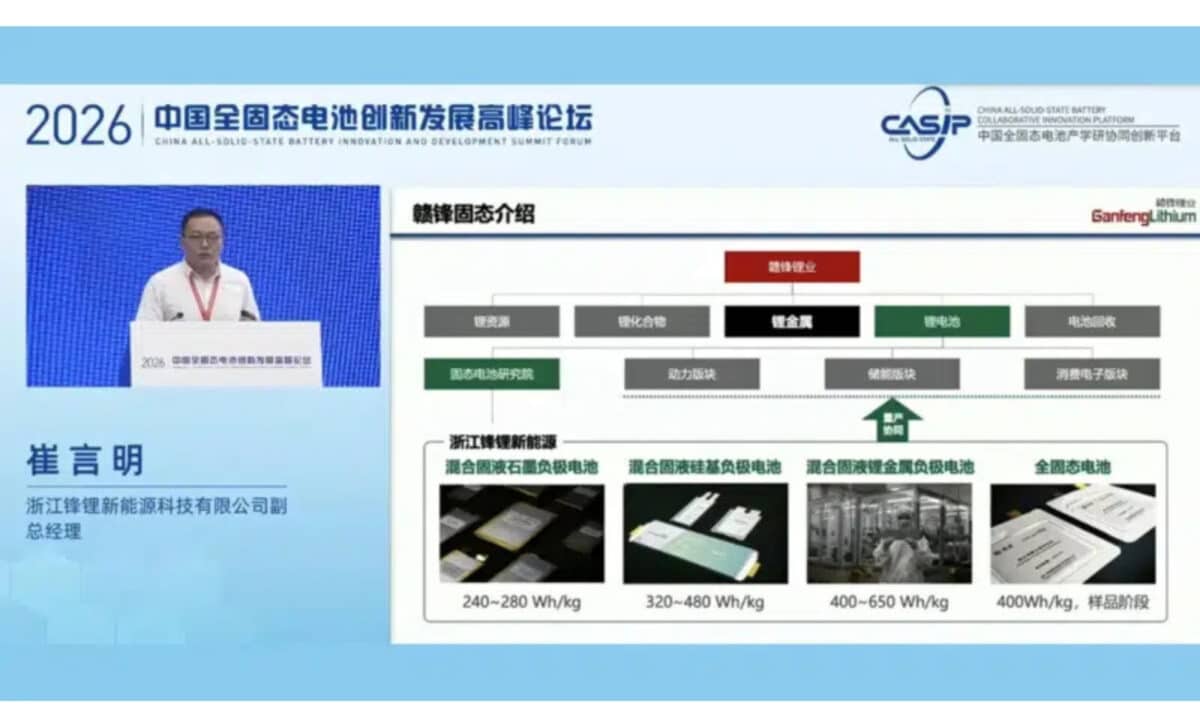
Company officials announced the development of a lithium-hybrid semi-solid-state battery with an energy density ranging from 400 to 650 Wh/kg. According to China’s Autohome, the new battery is currently designed for non-automotive applications, although the technology is expected to make its way into future electric vehicles.
The announcement was made during China’s All-Solid-State Battery Innovation and Development Summit Forum earlier this month. At the event, Ganfeng detailed progress on core materials designed to enhance battery stability and performance.
While the batteries are not yet deployed in passenger EVs, their mass production status sets them apart from many solid-state projects that remain at the laboratory or pilot stage.
A “Zero-Strain” Lithium Alloy Anode and Improved Thermal Stability
At the summit forum, Ganfeng officials revealed that they had developed a “zero-strain” lithium alloy anode paired with a sulfur cathode. The company said this configuration improves both electrochemical and thermal stability while preventing unwanted lithium movement inside the cell.
According to the report relayed by Electrek, the lithium alloy anode expands by just 3% to 5% during a full charge and discharge cycle. The battery cells also passed nail penetration and heating tests, surviving temperatures of up to 250°C (482°F).
Ganfeng stated that more than 500 small-scale samples were evaluated through a high-throughput screening process, with 20 progressing to mass production. In parallel, the company is advancing all-solid-state batteries, which are currently at the sample stage. During the event, Ganfeng said it hopes its work on lithium alloy anodes can contribute to the industrialization of high-energy-density all-solid-state batteries.
A Broader Push Toward Solid-State and Alternative Battery Chemistries
Ganfeng’s progress comes amid a wave of announcements in solid-state and semi-solid-state battery development. Earlier this month, China’s FAW Group said it had installed what it described as the industry’s first lithium-rich manganese semi-solid-state EV battery in a vehicle. The cell energy density exceeds 500 Wh/kg, and the total battery pack capacity reaches 142 kWh, enabling more than 1,000 km (620 miles) of CLTC range.
Several major automakers and battery manufacturers, including BYD, CATL, Volkswagen, Toyota, and Mercedes-Benz, are planning to begin small-scale solid-state battery production around 2027 or 2028, with mass production targeted toward the end of the decade.
Solid-state batteries are often referred to as the “holy grail” of EV battery technology because of their potential for higher energy density, longer driving range, and faster charging. At the same time, lithium iron phosphate, sodium-ion, and other battery chemistries are gaining ground as lower-cost, safer, and longer-lasting alternatives.