
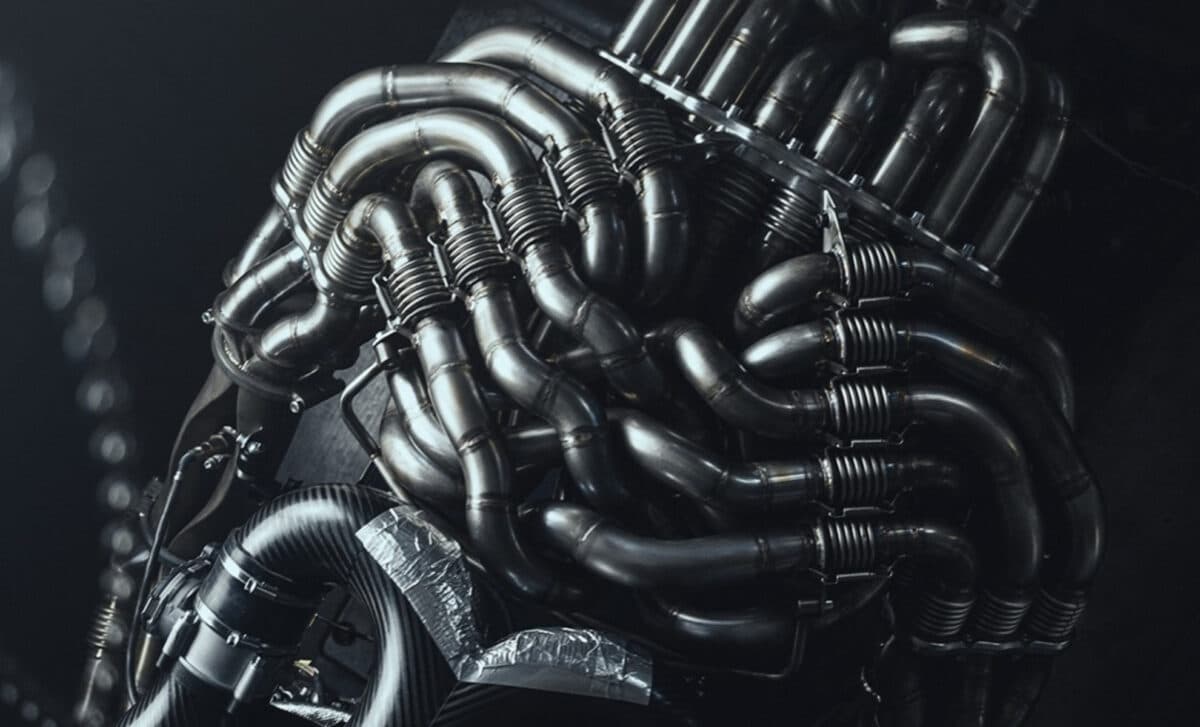
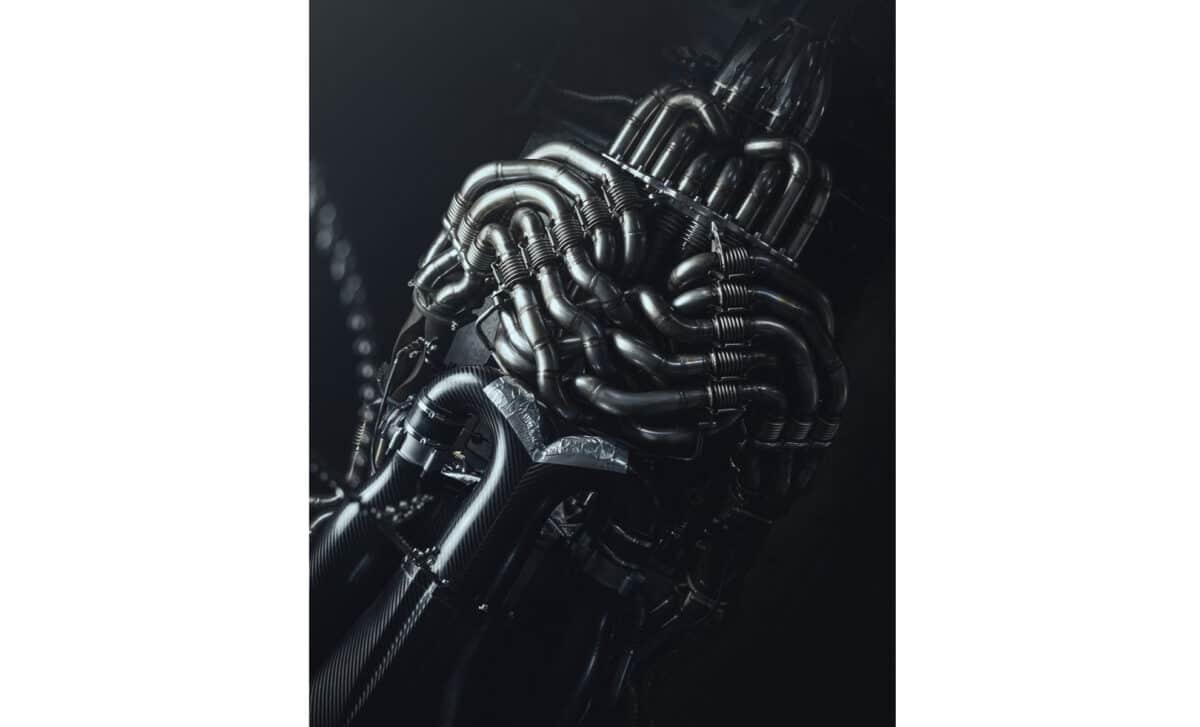
Two rows of welds. A tangle of pipes that seems to breathe on its own. A tailpipe that looks like it could propel a spaceship. At first glance, the De Tomaso P900’s new V12 engine doesn’t just resemble a machine, it looks like it escaped from a film set. But behind its dramatic styling lies a serious piece of automotive engineering.
The P900, revealed in final form earlier this week, is De Tomaso Automobili’s most radical car to date. And at the heart of it sits one of the most visually and mechanically ambitious naturally aspirated engines in recent memory. With a price tag of $3 million and only 18 units to be built, the P900 is neither a showpiece nor a concept, it’s headed to the track.
A V12 With No Shortcuts
The specs speak for themselves: a 6.2-liter V12, no turbochargers, no hybrid assistance, and a redline at 12,300 rpm. Peak output is 900 horsepower, all sent to the rear wheels via an Xtrac transmission. The engine has been designed to run on synthetic fuel, positioning it within an emerging effort to reconcile combustion performance with emissions goals. According to Car and Driver, the engine took four years to develop, twice as long as initially expected.
Interestingly, the V12 was not always part of the plan. De Tomaso originally equipped early P900s with a Judd-sourced V10, a solution that allowed the carbon-fiber monocoque to begin testing while the in-house V12 was still in development. That interim solution, while impressive, never aimed to be permanent.
Form Follows Fearsome Function
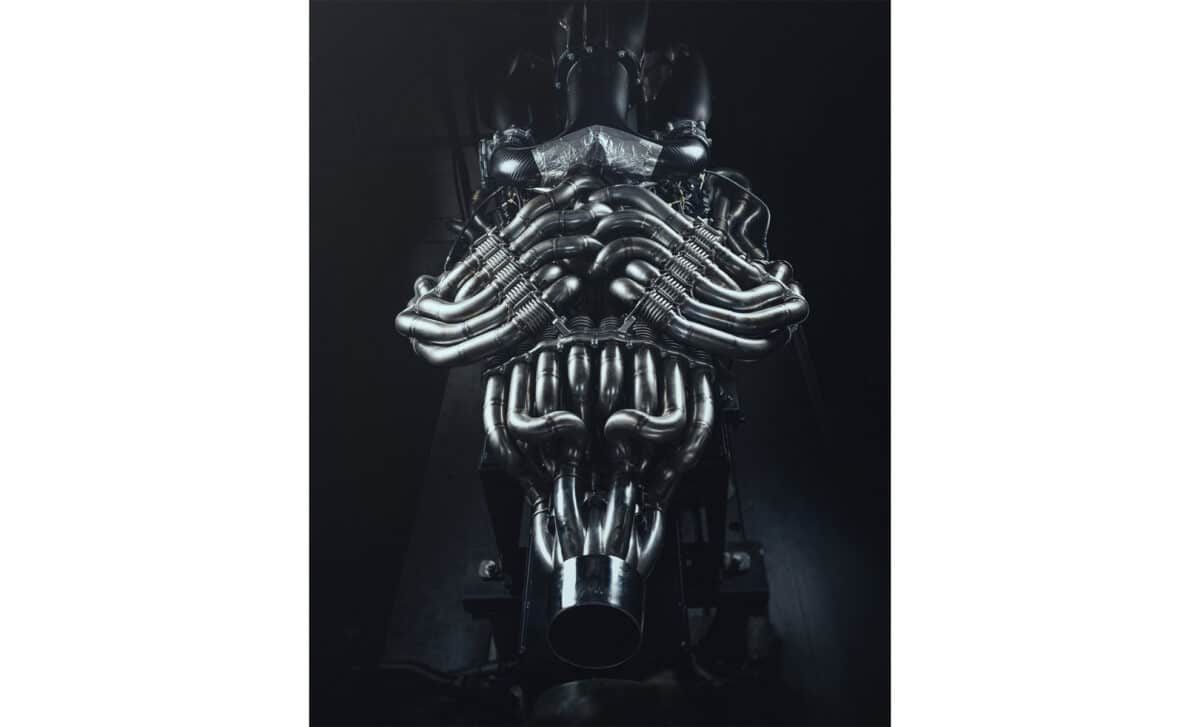
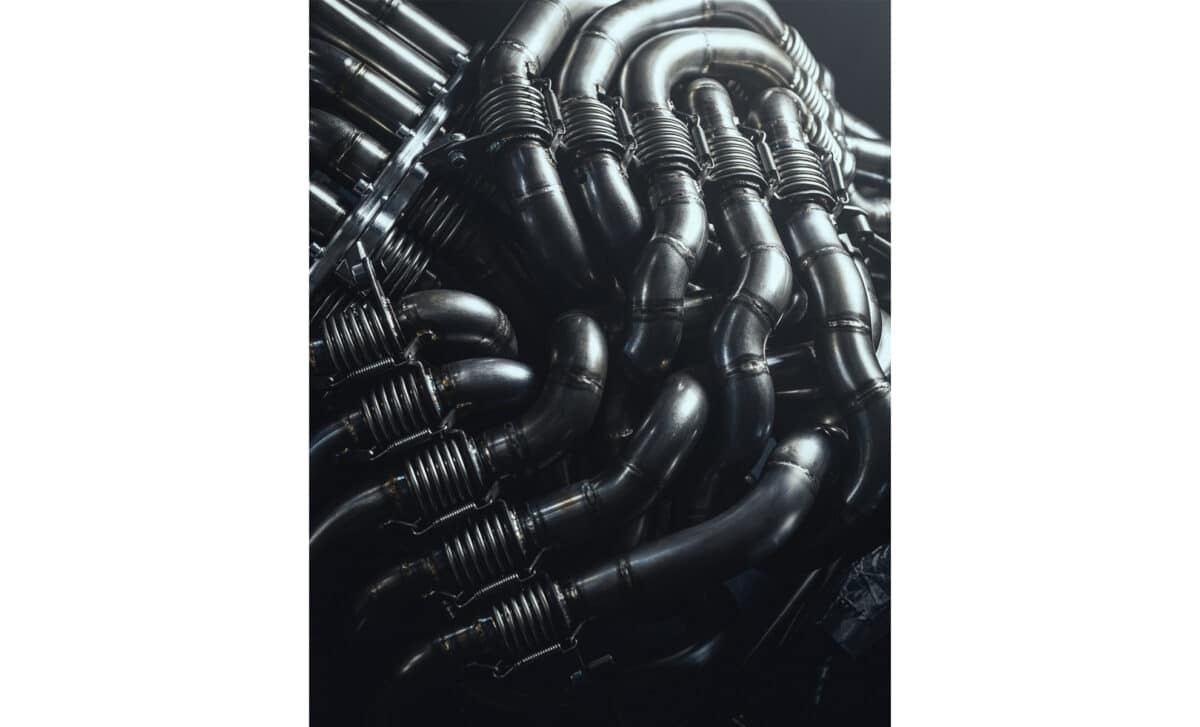
In its final configuration, the P900’s engine is unlike anything currently in production. Photos released by the company show a web of exhaust piping that appears to double the volume of the engine itself, reports Car Buzz. These aren’t clean, minimalist manifolds: they’re complex, visibly hand-welded, bolted together in segments, with extensive heat shielding and auxiliary lines. The 12:1 exhaust manifold design terminates in a cylindrical outlet that resembles a jet turbine more than a car part.
Whether this setup offers measurable performance advantages or is largely aesthetic remains to be confirmed. Still, the scale and intricacy suggest a clear intention: to treat the engine bay as a form of mechanical sculpture, one in which function is amplified rather than hidden.
No Compromise on Weight or Purpose
Beyond the headline numbers, the P900 is committed to a singular goal: pure track performance. There is no hybridization, no all-wheel drive. The V12 acts as a stressed member of the chassis, a layout that reduces structural weight and improves rigidity. At under 1,984 pounds, the car’s mass is remarkably low for a modern hypercar.
In a market dominated by hybridized or electric powertrains, think Rimac or Ferrari SF90, De Tomaso’s approach feels almost out of step with current trends. Yet that’s part of its appeal. The P900 aims to compete with Koenigsegg, Bugatti, and Pagani not by copying their playbook, but by reviving a more visceral interpretation of performance.
According to De Tomaso, owners will have the option to store their P900s at the Nürburgring, where dedicated track time will be arranged. The logic is sound: very few places on Earth offer the kind of tarmac that could safely contain a car of this specification.
The Limits of Resurrection
This isn’t De Tomaso’s first attempt at reinvention. The brand, originally Italian, now with international backing, unveiled the retro-styled P72 in 2019, a car praised for its design but still awaiting production. The P900, by contrast, is more radical, both in design and in engineering.
Whether the company can deliver 18 fully assembled V12 hypercars, tested and track-ready, remains to be seen. De Tomaso’s recent updates suggest progress, but skepticism persists, particularly in a segment where “vaporware” is a persistent concern. That said, images of the real engine, released via Facebook, suggest that development has moved well beyond renders.
Echoes of the Past, Questions for the Future
The P900 doesn’t fit easily into any trend. It’s not about efficiency. It’s not designed for daily use. It doesn’t plug in. In that sense, it feels like a defiant closing chapter for the naturally aspirated supercar, something deliberately extravagant, both in concept and execution.
Whether that defiance becomes a legacy or a footnote will depend not only on De Tomaso’s ability to deliver but also on how the car performs once it’s unleashed. For now, it’s hard not to be impressed by a machine that looks like sci-fi, sounds like racing history, and insists on internal combustion in a world that’s already moved on. And maybe, just maybe, that howl at 12,300 rpm will be worth it.