
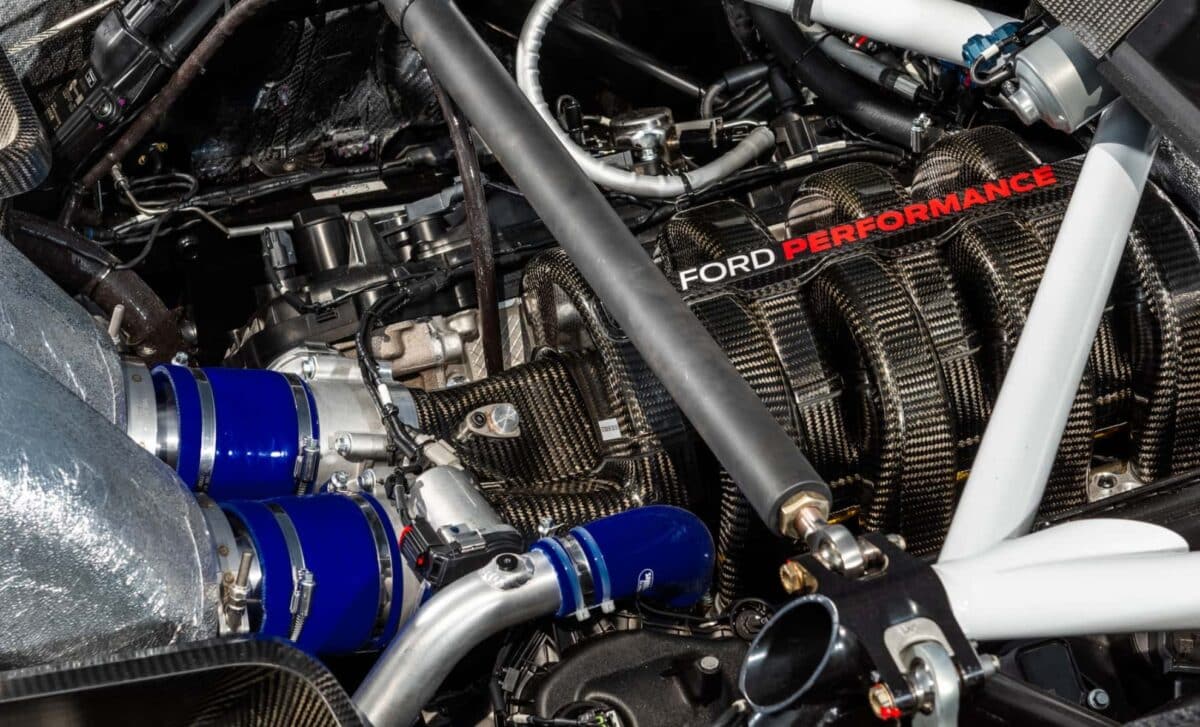
Set to debut in 2027, the engine is being developed entirely in-house by Ford and marks a bold move away from the turbocharged trend dominating endurance racing.
The unit is a direct evolution of the engines currently used in the Mustang GT3 and GT4, with engineering support coming from Ford’s Dearborn-based team and close coordination with Red Bull Ford Powertrains. The engine will be paired with a chassis from French manufacturer ORECA, and the program will follow the LMDh regulations, which enable manufacturers to compete at both Le Mans and in IMSA-sanctioned events.
Ford’s return to WEC signals its intent to fight for overall victories, stepping up from its previous efforts in the LMGTE Pro category. Unlike the Ford GT program that relied on EcoBoost V6 technology, this new project turns back to the brand’s V8 heritage, highlighting a change in philosophy and performance strategy.
In-House Engineering and Red Bull Collaboration
Ford is building the hypercar powertrain entirely in-house, a strategy the company says will give it more control and faster development cycles. “We are doing everything in-house. We’re doing that because we can react faster, we can learn faster, and we can bring that back to the production side of the business,” said Dan Sayers, manager of Ford Performance’s WEC Hypercar program, during a company briefing.
The engine shares its roots with the 5.0-liter Coyote V8 but is bored out to 5.4 liters for endurance use. The project benefits from Ford’s experience with the Mustang GT3 racing engine and takes into account lessons learned from previous GT competition efforts. Although full technical specifications are still under wraps, the powertrain is being tailored specifically to the rigors of long-distance racing.
The car’s chassis, developed by ORECA, will be part of the LMDh class, a platform that balances manufacturer flexibility with standardized components to control costs. The effort also involves coordination with Red Bull Ford Powertrains, hinting at potential technology sharing and future crossover into other forms of motorsport.
Scanning…
— Ford Racing (@FordRacing) January 16, 2026
Results: The 2026 Ford Mustang GT3, like you've never seen.#FRSeasonLaunch26 pic.twitter.com/57M4KHECef
Coyote V8 Platform Gets Pushed to the Limit
The decision to use a naturally aspirated engine in a field increasingly dominated by turbocharged hybrids is deliberate. While competitors like Toyota, Ferrari, Porsche, and BMW rely on forced induction, Ford is prioritizing reliability and simplicity, aiming to reduce the mechanical stress and complexity that can derail a 24-hour race.
This new application will be the most extreme use yet of the Coyote V8, a platform that has already proven itself across high-performance road cars and trucks, including the Mustang and F-150. Ford’s longtime motorsport partner M-Sport, which handles development for rally and Dakar programs, is also involved in refining the race-spec version of the engine.
Ford has already experienced success with smaller turbocharged engines, most notably the 3.5-liter EcoBoost V6 used in the GT that won Le Mans in 2016. But the return to a naturally aspirated V8 reflects a renewed focus on mechanical robustness and traditional performance characteristics. The engine’s lineage and adaptability make it a strong candidate for Ford’s endurance ambitions.
Driver Lineup and Road to 2027
Ford’s 2027 WEC driver roster will feature Sebastian Priaulx, Mike “Rocky” Rockenfeller, and Logan Sargeant. Before the hypercar takes to the grid, Priaulx and Rockenfeller will compete in the European Le Mans Series’ LMP2 class in 2026, a strategic move to build familiarity and continuity ahead of the WEC campaign.
The LMDh car will be eligible for entry in both the FIA WEC and IMSA WeatherTech SportsCar Championship, making it a global racing platform. Ford’s shift from the LMGTE Pro category to the top Hypercar class signals a significant step up, aligning the company with manufacturers vying for overall wins at Le Mans and other iconic endurance events.
In a field full of turbochargers and hybrid systems, Ford’s naturally aspirated V8 will stand out, not just for its configuration, but for what it represents. This is more than just a race engine; it’s part of a broader performance message Ford wants to send, both on the track and back on the production line.