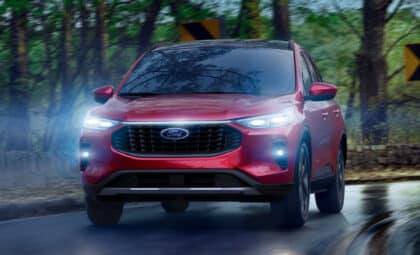

Through a series of videos published on a dedicated webpage, Ford has showcased design sketches, cold-weather testing prototypes, and elements of the manufacturing process that will underpin the new truck. While many specifications remain undisclosed, the material provides a clearer picture of the company’s ambitions for its next-generation electric pickup.
The project comes as Ford continues work on a smaller and more affordable electric truck despite stepping back from the F-150 Lightning. The company is developing the model on a dedicated platform and is targeting a combination of utility, efficiency, and lower production costs.
Early Design Sketches Point to a Compact, Boxy Pickup
Several design sketches shown in Ford’s video series suggest the future truck will adopt a relatively boxy shape, with vertical headlamps and a profile that appears closer to a car than a traditional full-size pickup.
Additional footage featuring camouflaged prototypes undergoing cold-weather testing supports the idea of a truck comparable in size to the Ford Maverick. The prototypes appear to feature a relatively short cargo bed, reinforcing expectations that the vehicle will occupy the midsize segment.
Ford has not confirmed the truck’s final design or name. Rumors have suggested the possible return of the Ranchero nameplate, though the automaker has made no announcement on that front.
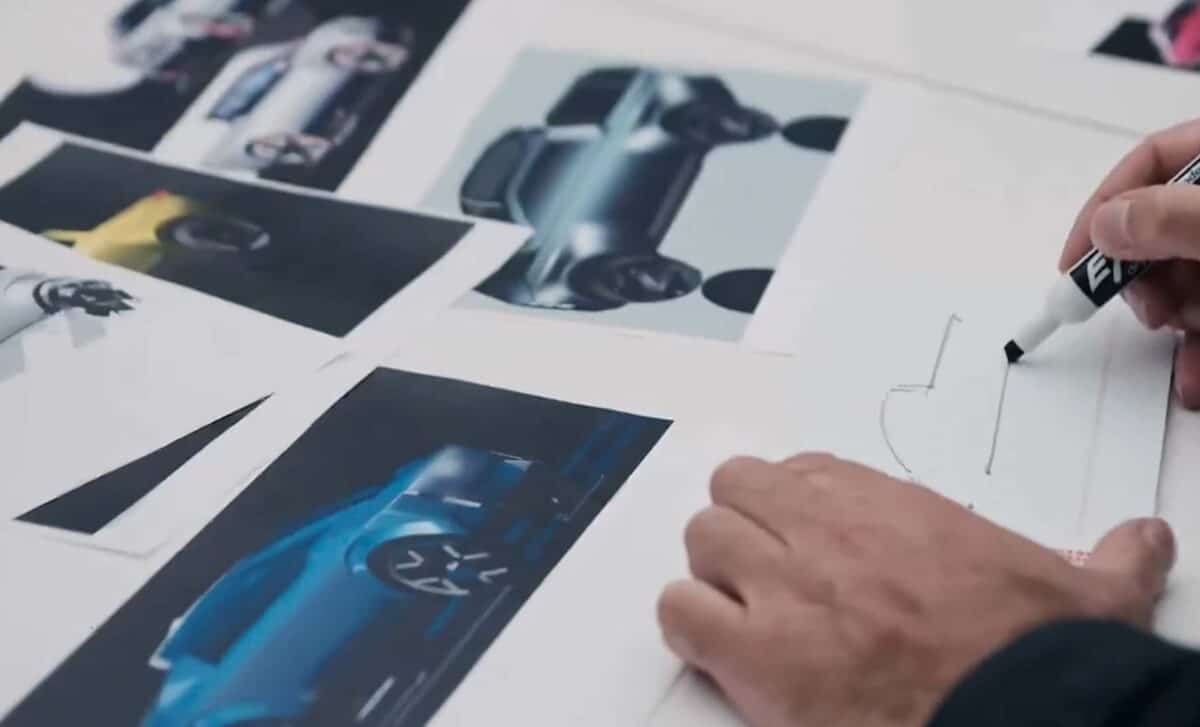
A New Platform Built Around Megacastings and Simplified Assembly
The electric pickup is being developed on Ford’s new Universal Electric Vehicle (UEV) platform, a dedicated architecture designed specifically for future electric models.
According to information shared by Ford, the vehicle will make extensive use of megacastings, large structural components intended to reduce the number of individual parts required during assembly. The truck will be built from three primary sections: a front section, a middle section, and a rear section.
Ford has previously explained that these sections will be assembled separately before being joined together near the end of the production process. One of the newly released videos shows the front portion being attached to the main chassis in a factory area known internally as “The Chapel of Love,” where the two sections are “married.”
The footage also shows workers using bolts and adhesive during assembly. Mark Gentry, an employee at Ford’s New Model Program Development Center, said he has been building Ford prototypes for 27 years and that “nothing has gone together as easily as the new EV.”

Smaller Battery Packs, 400-Volt Architecture and Built-in Power Export
Ford has yet to disclose full powertrain specifications, but the company has offered several indications regarding the truck’s battery strategy.
The vehicle could be equipped with either a lithium iron phosphate (LFP) battery or a nickel manganese cobalt (NMC) battery. Ford has suggested that maximum battery capacity will be around 51 kilowatt-hours, roughly half the capacity offered by the least expensive version of the F-150 Lightning.
The automaker argues that the new pickup will still provide sufficient driving range because it has been designed to be lighter and more aerodynamic than larger electric trucks.
The battery system will operate on a 400-volt architecture rather than the 800-volt systems increasingly found in newer electric vehicles. Ford says the choice allows compatibility with existing charging infrastructure while helping keep costs under control.
Vehicle-to-load functionality will be included as standard, enabling owners to use energy stored in the battery to power tools and appliances. Ford also confirmed that both two-wheel-drive and all-wheel-drive configurations are under development.
The company further stated that the electric motors will be produced in-house and described them as the cheapest in the world, a measure aimed at reducing manufacturing costs and maintaining a lower selling price.
Ford has said the pickup will offer the interior space of a midsize truck within the footprint of a Maverick. The company also claims it will be as fast as a gasoline-powered Mustang EcoBoost and provide more usable space than a Toyota RAV4 thanks to the combination of a front trunk and rear cargo bed. The new electric pickup is expected to make its debut next year.