


Brighter headlights have become increasingly common with the widespread adoption of LED lighting, but stronger illumination has also intensified complaints about glare from approaching vehicles. On dark roads or around bends, excessively bright headlights can affect visibility and driver comfort.
Audi’s response is not a newly developed concept but an established system that has been available in Europe since 2013. Its arrival in the U.S. market was delayed by federal regulations until a rule change by the Department of Transportation in 2022 allowed the company to move forward with certification and deployment.
A Technology Delayed By Regulation Reaches The U.S. Market
Audi’s Digital Matrix headlights have been in use in Europe for more than ten years, where they were developed to adapt light output in real time and reduce the impact on other road users.
According to Car and Driver, the technology did not meet United States Department of Transportation requirements until regulatory changes adopted in 2022 opened the path for approval. Following that change, Audi engineers worked to adapt the system to comply with federal standards.
The first American vehicle scheduled to receive the technology will be the 2027 Q9, positioned as Audi’s flagship three-row SUV.

Thousands Of Micro-leds Create A Controlled Lighting Pattern
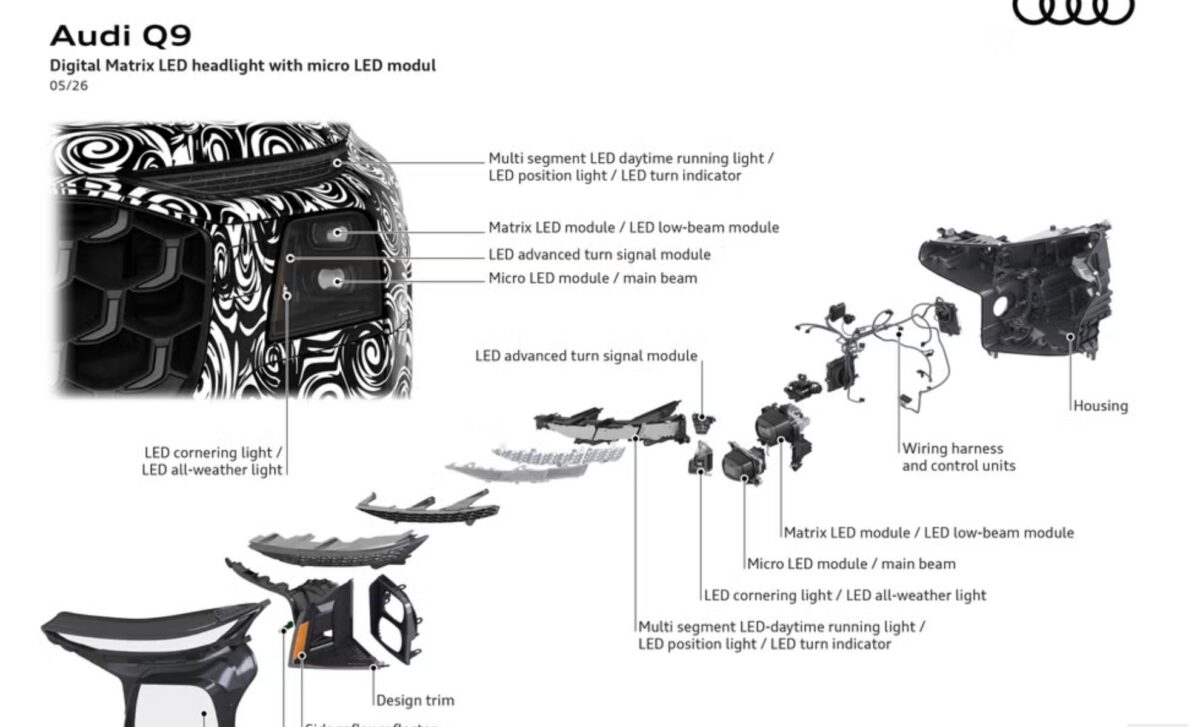
The Digital Matrix system relies on an architecture built around individually controlled points of light rather than a fixed beam pattern.
Each headlight on the Q9 contains 25,600 micro-LEDs. These lights are arranged in modules measuring approximately half an inch in width, while each LED itself measures only micrometers across.
This configuration allows the headlights to adjust illumination with high precision. Rather than switching between broad lighting modes, the system modifies specific portions of the beam through individual LED control.
Cameras And Adaptive Dimming Aim To Reduce Glare
Audi’s system uses front-facing cameras to identify approaching vehicles, building on functionality already present in vehicles equipped with automatic high-beam dimming.
What distinguishes Digital Matrix headlights is their ability to dim selected LEDs dynamically as another vehicle changes position during passing. Audi describes this process as creating a rolling adjustment across the beam rather than reducing overall brightness.
The result is an adaptive light cone intended to keep high-beam visibility available for the driver while limiting direct glare toward oncoming traffic. The company presents the technology as a way to improve nighttime driving conditions without affecting visibility for surrounding road users.