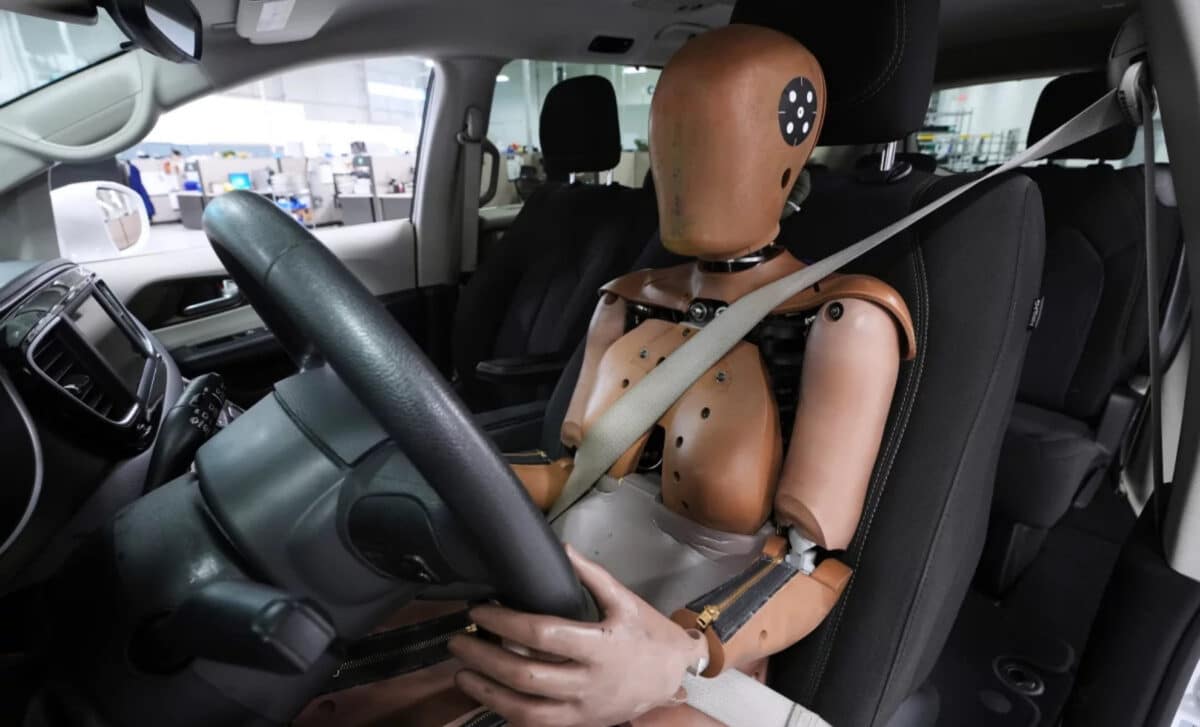
The announcement marks a long-overdue shift in crash safety standards that have relied on male-based models since the late 1970s. With female drivers and passengers facing up to 73% higher injury risks in certain collisions, the approval of THOR-05F represents a significant federal response to long-standing concerns.
Transportation Secretary Sean Duffy unveiled the dummy during a safety research event in Washington, D.C., framing the move as a commitment to reducing preventable harm on American roads. Developed by Humanetics, a leading crash-test dummy manufacturer, THOR-05F incorporates more than 150 sensors and advanced biomechanics tailored to the female body. The dummy is not expected to be used in formal testing until at least 2027, but the release of its specifications marks the first concrete regulatory step toward change.
Rethinking Car Safety After Decades of Male-Centric Testing
Until now, vehicle safety testing in the U.S. has relied primarily on the Hybrid III dummy — a model introduced in the late ’70s and based on a 5-foot-9, 171-pound male. Even the “female” version of this dummy was essentially a scaled-down male with minor cosmetic modifications, according to MotorTrend. It lacked anatomical precision and failed to account for how female bodies respond differently to impact.
Studies have shown that women are not only more likely to be seriously injured in car crashes, but also 17% more likely to die compared to men in similar scenarios. This disparity has fueled growing pressure from both safety advocates and lawmakers to update crash testing standards.
Among them is Maria Weston Kuhn, founder of the nonprofit Drive Action Fund, who suffered life-altering injuries in a crash and has since campaigned for more inclusive safety protocols.
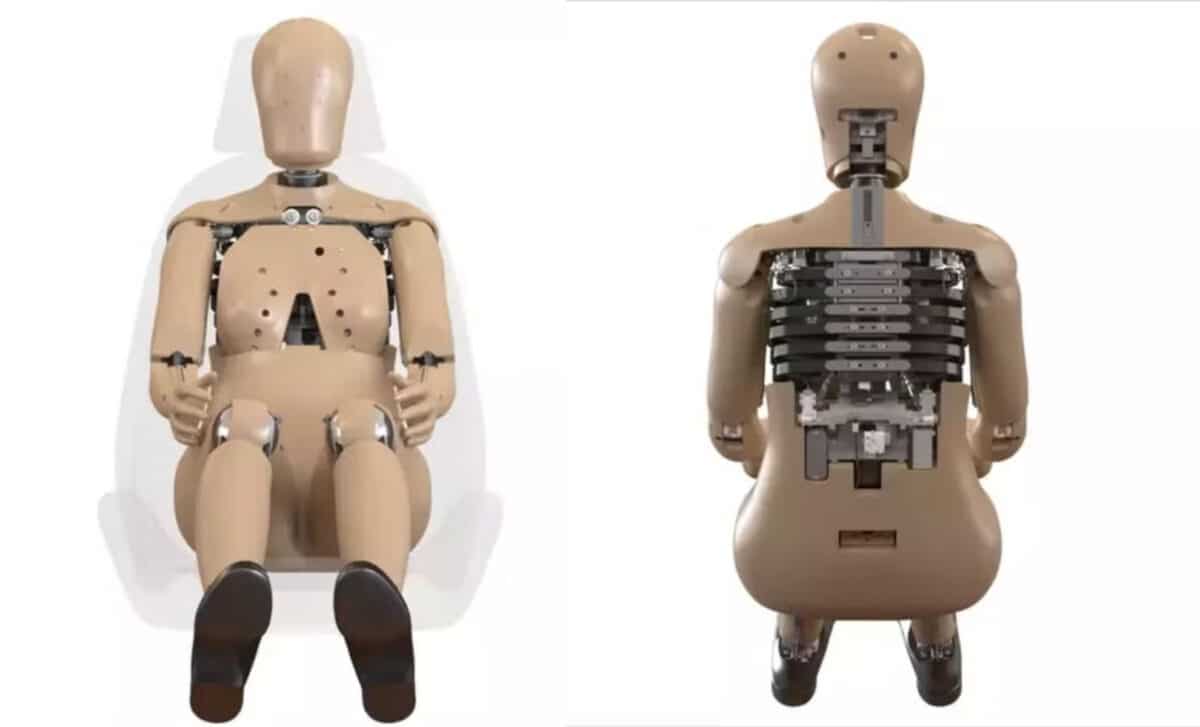
Thor-05F: A Design Informed by Female Anatomy
The THOR-05F dummy represents a leap in biomechanical fidelity compared to previous models. It is based on a fifth-percentile female, meaning it approximates the size and weight of the smallest 5% of adult women. But more importantly, it replicates how the female body actually moves and absorbs impact.
Unlike the Hybrid III, THOR-05F includes a flexible neck capable of forward, backward, twisting, and side-to-side motion. Its spine mimics human posture, whether slouched or upright, and its thorax measures chest deflection in four distinct areas. Sensors embedded in the abdomen, pelvis, and arms allow for detailed measurements of pressure and force — features that simply didn’t exist in previous dummy designs.
Chris O’Connor, CEO of Humanetics, emphasized the need for a more representative model, pointing out that female drivers are at nearly 80% higher risk for leg injuries than male drivers in identical crashes. “The crash test dummy was designed around a male, and that male became the baseline,” he told NBC News.
Path to Implementation and Political Support
Although the design has now been federally approved, the dummy’s actual integration into safety testing remains a few years away. The National Highway Traffic Safety Administration (NHTSA) is currently in the early stages of a regulatory process that could see THOR-05F included in Federal Motor Vehicle Safety Standards once a final rule is published.
Duffy acknowledged “years of delays” under previous administrations and credited recent momentum to renewed federal attention. Senators Tammy Duckworth and Deb Fischer, co-sponsors of the She DRIVES Act, both voiced support for the announcement. Fischer stated that it was “far past time” to make such changes permanent, while Duckworth underlined the urgency of eliminating unnecessary risk for women behind the wheel.
Still, advocates remain cautious. “We know the dummies won’t do any good sitting in the storage closet,” said Weston Kuhn. O’Connor echoed this sentiment, pointing to the need for a clear timeline to ensure automakers prepare appropriately and lives are not lost to continued inaction.