


The update arrives as competition intensifies in China’s electric vehicle market, where brands iterate quickly to stay ahead. Xiaomi, originally known for consumer electronics, has already made a strong impression with the SU7, a sedan that drew comparisons to the Porsche Taycan and sold out rapidly after launch.
The refreshed version, revealed through early test drives in Beijing, shows how the company is responding to feedback while aligning the model more closely with its newer YU7 crossover. The changes may appear modest on paper, but collectively reshape the driving and ownership experience.
Subtle Exterior Tweaks and Safety-Driven Changes
Visually, the SU7 remains largely unchanged, retaining its original silhouette with only minor adjustments to the front and rear bumpers, along with new wheel and color options. The most notable exterior revision concerns the door handles.
Xiaomi has replaced its previous hidden handles with new electronic units that feature a flip-up mechanism and manual operation. According to InsideEVs, the change follows safety concerns and regulatory pressure linked to the earlier design.
These updates reflect a broader trend in the Chinese market, where rapid iteration is not only about performance or design, but also compliance and usability improvements introduced within short product cycles.

A More Premium and Quieter Interior Experience
Inside, Xiaomi has focused on improving perceived quality and usability. The center console has been redesigned to align more closely with the YU7 crossover, and the cabin now includes screw-in ports for Xiaomi-developed accessories integrated into the dashboard.
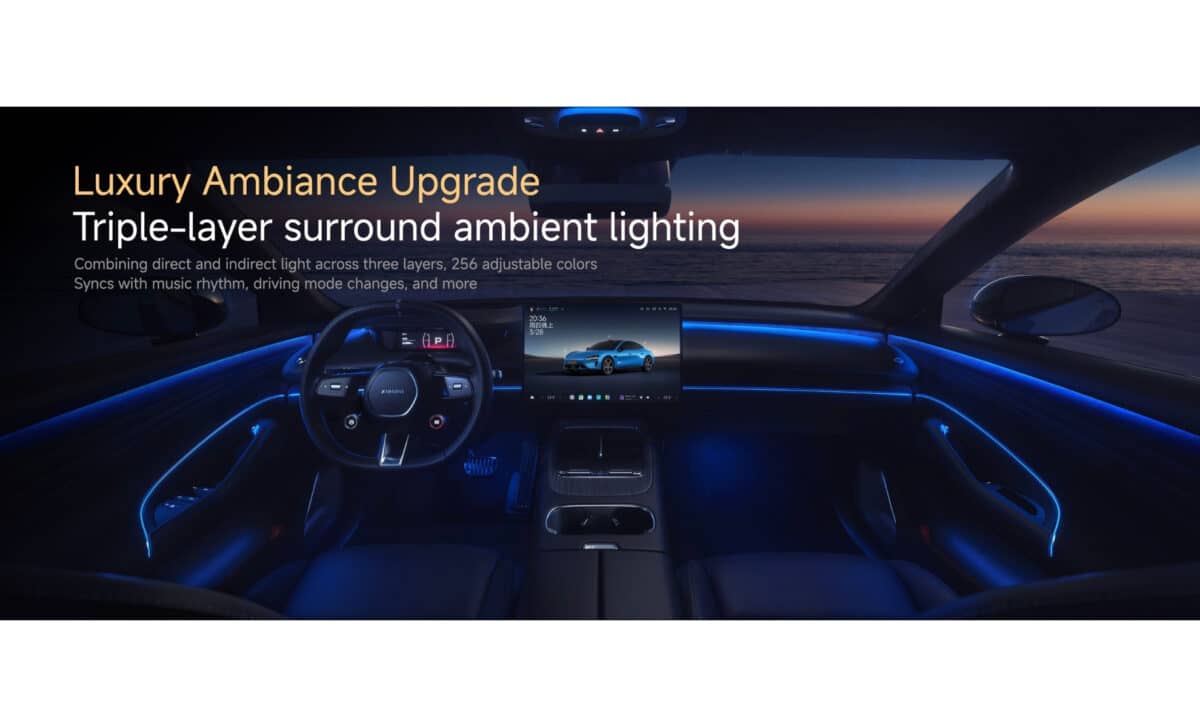
Material upgrades are also evident. The SU7 now features laminated glass and additional soft-touch surfaces on the dashboard and upper door panels. Reviewers highlighted a noticeable improvement in cabin ambiance.
Mark Rainford from Inside China Auto noted the car’s quietness, though he added that some competitors may still offer slightly better noise isolation. All four reviewers who tested the vehicle agreed that the interior feels more premium than before.
Mechanical Upgrades Boost Performance and Efficiency
Beneath the surface, the updates are more substantial. Xiaomi has revised the platform and structural elements to improve safety and driving dynamics, including a new crossmember that splits the glass roof into two sections.
Performance gains are also evident. The updated “V6s Plus” electric motor replaces previous variants and delivers quicker response, spinning up to 1,000 RPM faster. Output increases from 299 horsepower to 320 horsepower on the base model, while the Max version reaches 690 horsepower, a 17-hp increase.
The SU7 now features an 800-volt architecture across all trims, rising to nearly 900 volts on the Max variant. This enables faster charging and extended range, with the top configuration reaching 902 kilometers on the WLTC cycle and adding up to 670 kilometers of range in 15 minutes.
Driving impressions also point to meaningful improvements. Eliott Richards from Everything Electric APAC described the revised pedal tuning as more natural, stating that the modulation feels closer to that of an internal combustion vehicle. Meanwhile, Will Sundin of China Driven praised the car’s handling and turn-in capability.
The updated SU7 also introduces a more powerful ADAS computer and makes LiDAR standard across all models, reinforcing Xiaomi’s focus on advanced driver assistance.
Xiaomi began sales of the revised SU7 in China last week and plans to expand into international markets by 2027, signaling broader ambitions beyond its domestic success.