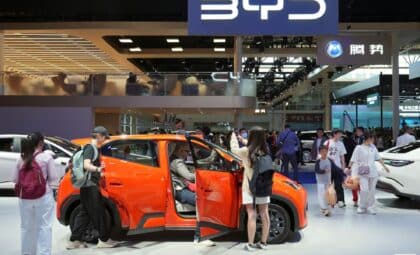

After establishing itself as a dominant force in China’s automotive market, BYD is now focused on expanding its international presence. The company is seeking growth beyond its domestic market, where increased competition has weighed on sales and share prices.
The announcement comes at a time when Chinese automakers are increasingly looking overseas for new customers. As BYD pushes into markets across Asia, the Middle East, Europe, and North America, its growing scale is attracting attention not only from competitors but also from policymakers.
BYD Sets Its Sights on the Top Spot in the Global Auto Industry
Speaking to shareholders at the company’s annual meeting in Shenzhen, BYD Chairman Wang Chuanfu said the automaker’s ambitions remain unchanged despite challenges in its home market.
Wang told investors that “BYD will truly become the number one automaker globally in terms of scale in five years.”
BYD first introduced an internally developed passenger car in 2005 and launched its first battery-electric vehicle in 2009. Last year, the company sold approximately 4.6 million vehicles, a performance that made it the sixth-largest automaker in the world by sales volume.
That figure remains significantly below the volume achieved by Toyota during the same period. The Japanese automaker sold more than twice as many vehicles, highlighting the scale of the challenge BYD faces as it seeks to move to the top of the global rankings.
Overseas Expansion Becomes a Central Growth Strategy
Rising competition within China has pushed many domestic manufacturers to seek growth abroad, and BYD has made international expansion a central part of its strategy. BYD increased its annual exports by 65% year over year in 2025. The company plans to sell 1.5 million vehicles outside China in 2026.
The automaker has already expanded its presence in regions traditionally dominated by established global brands. Reuters reported that BYD and other Chinese manufacturers have gained market share by expanding into Southeast Asia and the Middle East, areas where Toyota has historically maintained strong sales.
Europe remains one of BYD’s primary targets for future growth. The company is also focusing on North America. Mexico experienced a significant increase in BYD imports last year, while Canada has emerged as another priority market. More than half of Canadians are interested in purchasing a Chinese electric vehicle.
Pentagon Designation Prompts a Response From BYD
While BYD’s global sales strategy continues to advance, the company is also facing increased attention from the United States government.
This week, the U.S. Department of Defense added BYD to its Section 1260H list. The designation identifies companies that the Pentagon considers to have ties to the Chinese military. Other companies included on the list are Alibaba, Baidu, and NIO.
According to the Pentagon report, BYD was designated as “a military-civil fusion contributor to the Chinese defense industrial base” because of its affiliation with China’s Ministry of Industry and Information Technology and because it is located in or affiliated with a military-civil fusion enterprise zone.
The designation prevents BYD from obtaining contracts with the U.S. government. The report notes that the move is unlikely to affect the company’s vehicle sales in the United States in the near term because BYD does not currently sell passenger cars in the U.S. market.
BYD has rejected the allegations. Stella Li, President of BYD North America and Executive Vice President of BYD, responded to the Pentagon’s action by stating: “BYD is not a company that can be pushed around.” She added that the automaker intends to use its “legal weapons” to defend itself.
The dispute comes as BYD continues to pursue its objective of becoming the world’s largest automaker, while U.S. authorities maintain scrutiny of companies they believe have links to China’s military-industrial system.