
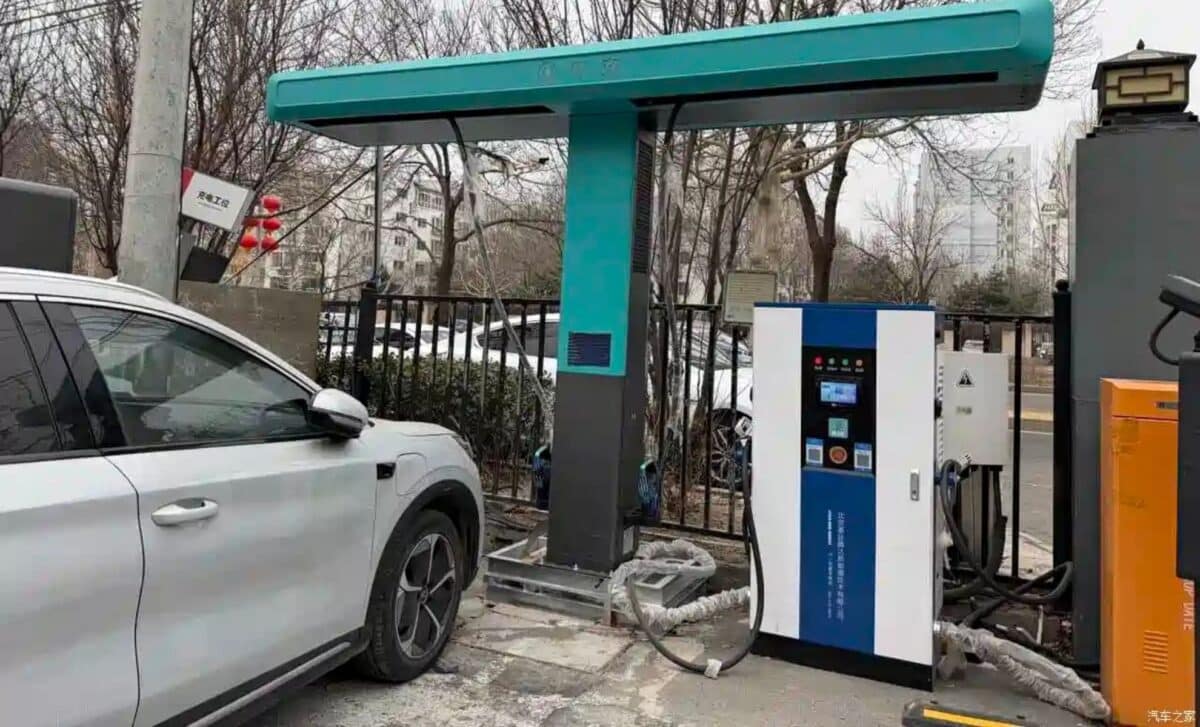
The announcement comes as BYD continues to expand its footprint in electric mobility and charging infrastructure. The company has previously demonstrated a 1,000kW charger, and this new system represents a significant step up in power capacity. Images published by Autohome show the unit installed ahead of its official presentation.
Beyond charging hardware, the March 5 press conference will also introduce a second-generation Blade battery and upgrades to BYD’s “God’s Eye” advanced driver assistance system. Together, these updates signal a broader push across hardware and software platforms.
Charging Hardware Rated at 1000V and 1500A
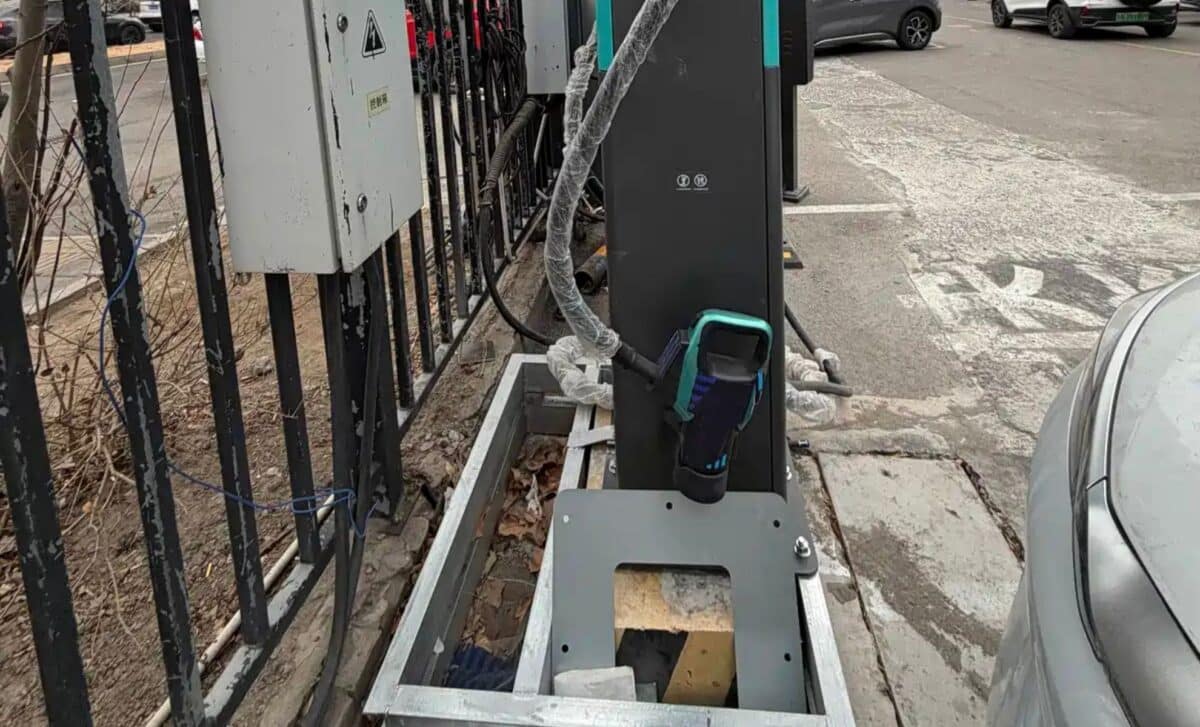
According to Electrek, the photographed charger carries a label indicating it was manufactured by BYD in January 2026. The specifications list 1000 volts and 1500 amps, resulting in a total capacity of 1,500kW when multiplied.
The label had reportedly been covered, but the individual who took the images pulled it back to reveal the technical details. Such power levels are rarely seen outside heavy-duty applications.

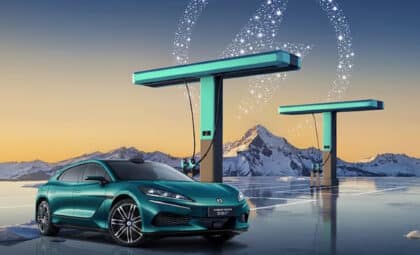
The charging station itself features overhead cables suspended from a T-shaped structure. As reported by Autohome, this configuration allows cables to extend more easily to different vehicle charge ports while preventing them from resting on the ground, where they could be run over, accumulate dirt, or sustain damage.
BYD previously showcased a 1,000kW charger. If confirmed, the 1,500kW version would represent a 50 percent increase in charging capability. Another leak earlier this month, suggested that a 2,100kW charger may be in development.
Performance Claims of 2KM of Range per Second
Technical reports cited by CarNewsChina point to a peak output of 1,360kW under certain conditions. At that level, an electric vehicle could theoretically gain 2 kilometers (1.2 miles) of range per second.
According to those reports, this would amount to roughly 400 kilometers (248 miles) of range in five minutes, taking into account the typical reduction in charging speed as a battery approaches higher states of charge.
There is still uncertainty about whether each individual connector will be capable of accessing the full 1,500kW, or the rumored 2,100kW. The stations could distribute total power across multiple charging heads, which would affect the maximum output available per vehicle.
Vehicle compatibility also remains a determining factor, as cars must be engineered to accept such high charging rates in order to benefit from them.
Second-Generation Blade Battery and Software Enhancements
In addition to the charger, BYD is expected to introduce a second-generation Blade battery. According to Electrek, two variants are planned: one offering approximately 210Wh/kg energy density with up to a 3C charging rate, and another with 160Wh/kg density but a faster 8C charging rate.
Both versions reportedly exceed the energy density of BYD’s first-generation Blade battery and are expected to last up to 3,000 charge cycles.
The March 5 event will also include updates to the company’s “God’s Eye” driver assistance software. While detailed specifications have yet to be disclosed, the upgrade forms part of the broader technology refresh being presented.
Even for drivers who do not require five-minute charging sessions, higher-power chargers can improve throughput at public stations, particularly in urban areas where overnight home charging is not always available. The forthcoming presentation is expected to clarify how these new systems will be deployed and integrated into BYD’s expanding ecosystem.