
Electric vehicles have moved beyond early adoption, and owner experience appears to be driving continued loyalty. The latest findings come from the 2026 US Electric Vehicle Experience Ownership Study conducted by J.D. Power, which examines first-year ownership satisfaction across multiple criteria.
The results suggest that improvements in battery technology, public charging access, and overall vehicle performance are shaping consumer perception. The study also compares EVs with plug-in hybrids, highlighting significant differences in satisfaction between the two categories.
Satisfaction Reaches Record Levels Across Segments
Owner satisfaction with EVs climbed sharply in the 2026 study. On a 1,000-point scale, premium EVs scored 652, marking a 101-point increase from the previous year. Mass-market EVs reached 511, up 115 points from 2025.
According to J.D. Power, these gains reflect improvements in battery technology, charging infrastructure, and vehicle performance. Brent Gruber, executive director of the EV practice at J.D. Power, stated that these developments have driven customer satisfaction to its highest level ever.
The study found that 96 percent of EV owners would consider another electric vehicle for their next purchase or lease. That level of loyalty holds even among those who previously benefited from the $7,500 federal tax credit, which has since expired.
Public Charging Improvements Drive Confidence
One of the most significant improvements identified in the study was public charging availability. Satisfaction in this area rose for both premium and mass-market EV owners.
Most major brands have adopted Tesla’s North American Charging Standard, allowing access to the Supercharger network. At the same time, networks such as ChargePoint, Electrify America, and EVgo have continued expanding. According to the study results reported by Electrek, these developments have contributed to rising overall satisfaction in recent years.
The survey evaluated ten factors, including cost of ownership, battery range accuracy, availability of public charging, driving enjoyment, battery range, ease of charging at home, styling, safety and technology features, service experience, and overall quality and reliability.
Tesla and Ford Lead Their Respective Segments
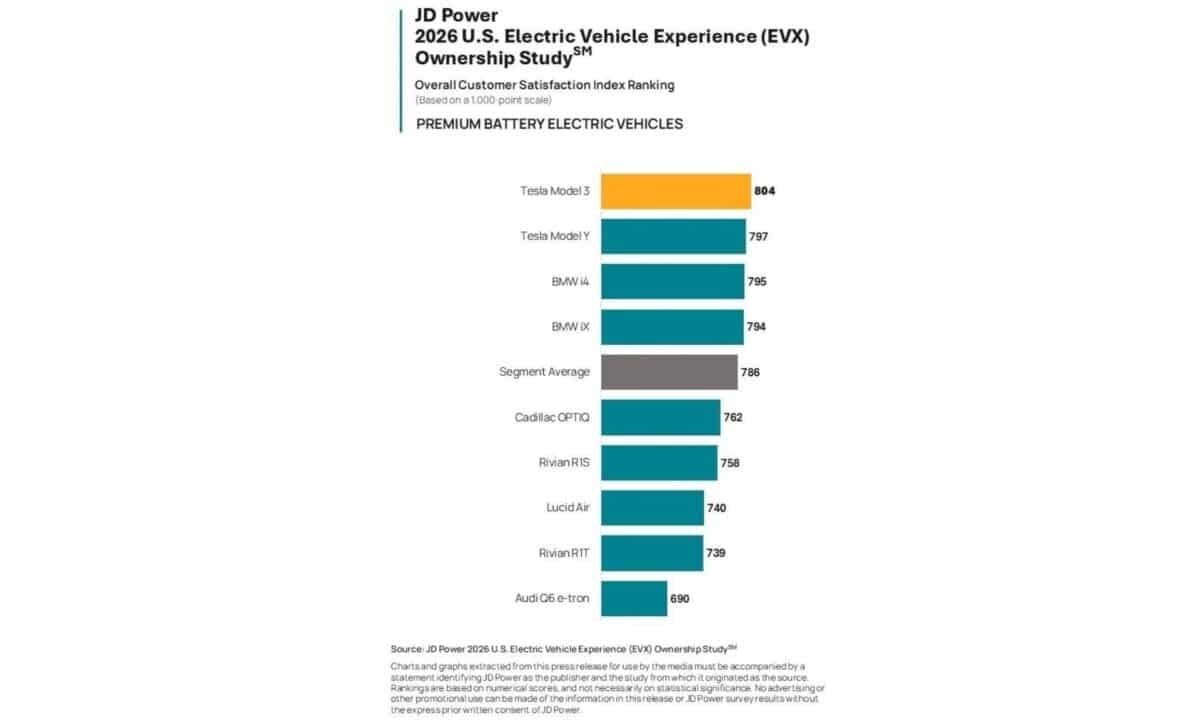
The study ranked specific models based on owner satisfaction. The Tesla Model 3 achieved the highest overall score at 804, leading both the premium category and the overall rankings. The Tesla Model Y followed with 797 points, while the BMW i4 placed third at 795.
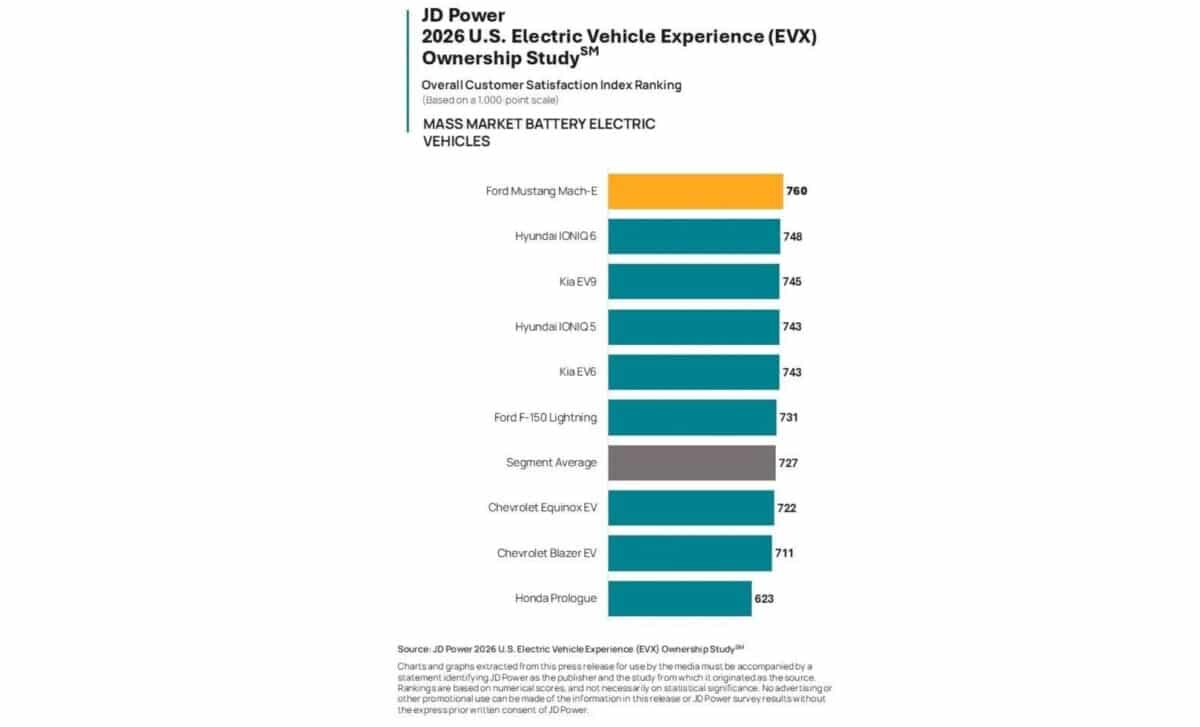
In the mass-market segment, the Ford Mustang Mach-E ranked first with a score of 760. The Hyundai IONIQ 6 followed at 748, and the Kia EV9 placed third at 745.
EVs also outperformed plug-in hybrids by wide margins. Premium EVs scored 114 points higher than premium PHEVs, 786 compared to their counterparts. In the mass-market segment, EVs scored 727, exceeding PHEVs by 117 points.
This marks the sixth year that J.D. Power has released its US EVX Ownership Study. Conducted in collaboration with PlugShare, the 2026 edition surveyed 5,741 EV and PHEV owners with 2025- or 2026-model-year vehicles, focusing specifically on first-year ownership experience.