
The findings come as temperature-related performance continues to shape consumer perceptions of electrified vehicles. While battery sensitivity to cold is widely recognized, the behavior of hybrid systems under similar conditions has received less attention.
Conducted under controlled conditions, the study offers a direct comparison between EVs and hybrids in both cold and hot climates. It highlights not only efficiency losses but also the cost implications tied to different charging scenarios.
Controlled Testing Reveals Measurable Efficiency Losses
Six vehicles were tested on a dynamometer at a baseline temperature of 72°F (22°C), with climate control systems set to the same level. According to InsideEVs, the EV lineup included a 2025 Chevrolet Equinox EV (front-wheel drive), a 2025 Tesla Model Y (rear-wheel drive), and a 2025 Ford Mustang Mach-E (all-wheel drive). The hybrid group consisted of a 2025 Toyota Prius (front-wheel drive), a 2026 Honda CR-V (all-wheel drive), and a 2025 Hyundai Tucson (all-wheel drive).
None of the vehicles were new, with mileage ranging from 3,721 to 13,296 miles. This detail matters, even if slightly, as it reflects more realistic usage conditions rather than idealized lab scenarios.
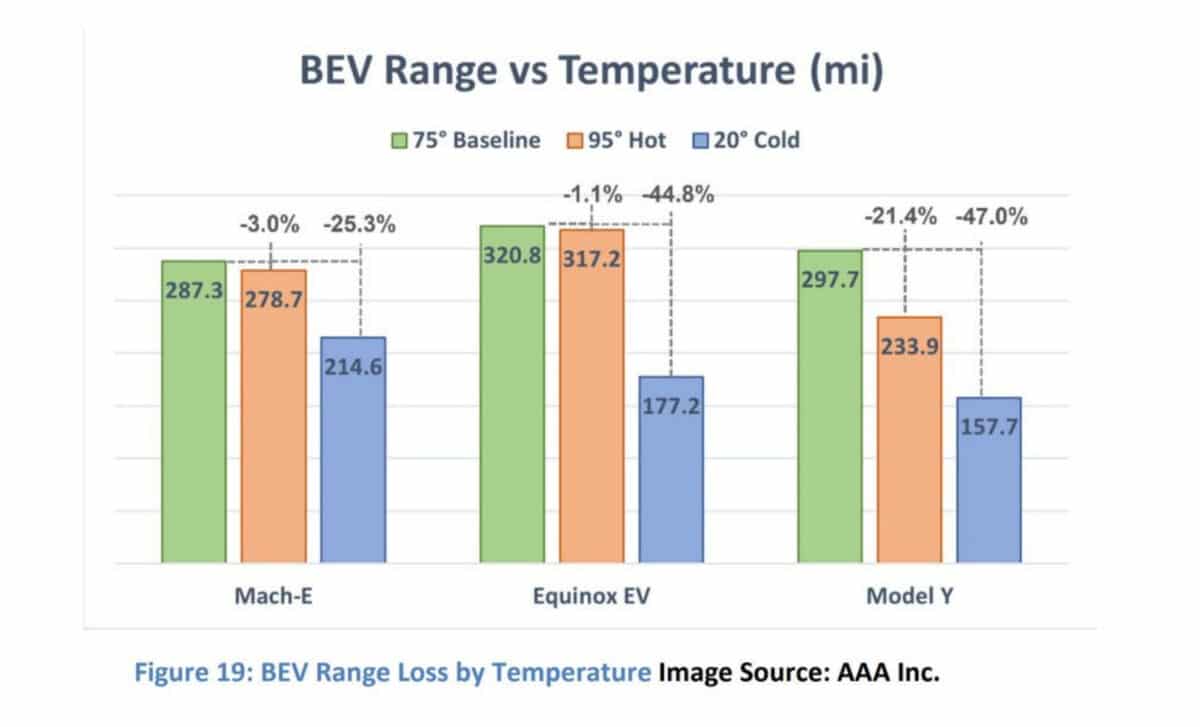
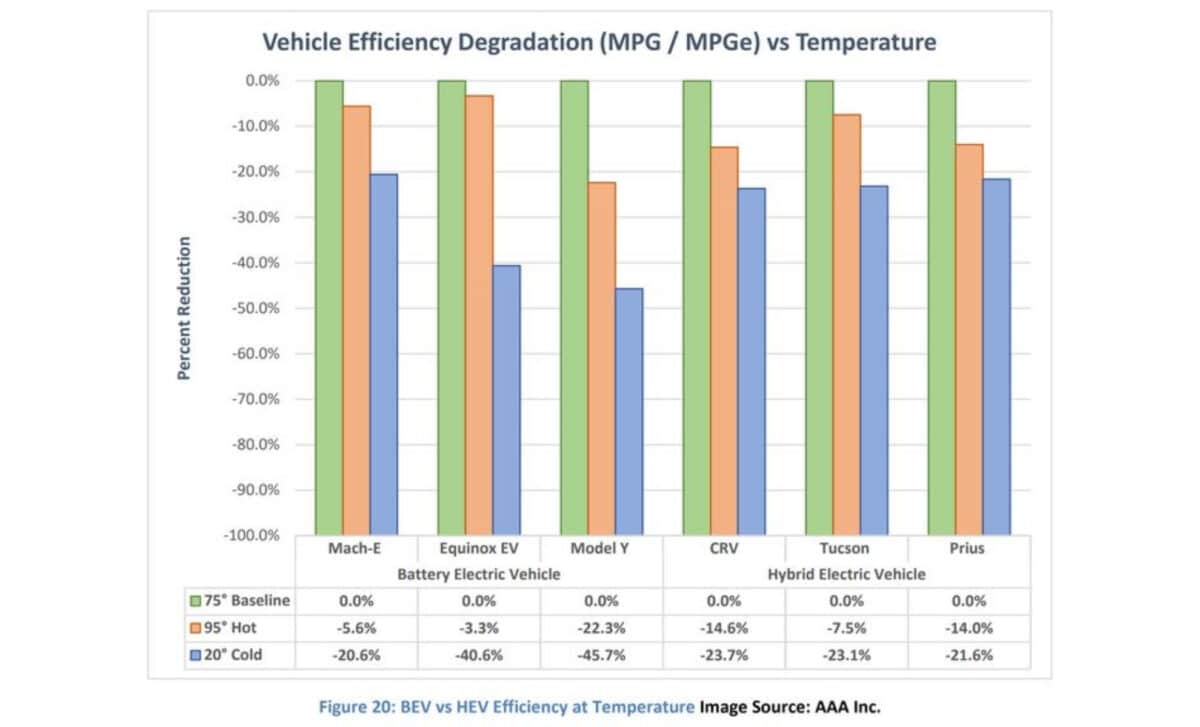
At 20°F (-6.6°C), EVs experienced an average MPGe efficiency drop of 35.6%, leading to a 39% reduction in range. Hybrids, while less affected, still saw a 22.8% decrease in fuel economy. According to AAA, the Tesla Model Y Long Range showed the largest deviation from its baseline performance among the EVs tested.
Heat Impacts Both Powertrains, Though Less Severely
Efficiency losses were also observed at higher temperatures, though to a lesser extent. At 95°F (35°C), EV efficiency dropped by 10.4%, with an 8.5% reduction in range compared to baseline conditions.
Hybrids recorded a 12% decrease in efficiency under the same heat conditions. According to the study, this confirms that temperature extremes, whether hot or cold, affect both types of vehicles, though the impact is more pronounced in colder environments.
These changes translate directly into reduced driving range, requiring more frequent refueling or charging to cover the same distance. It’s a straightforward consequence, though one that still surprises some drivers.
Cost Advantage for EVs Depends on Charging Method
Despite greater efficiency losses in cold weather, EVs maintain a cost advantage, under specific conditions. Driving an EV for 1,000 miles at 20°F costs an average of $87.75, which is $36.20 or 29% less than a hybrid.
This advantage applies primarily when charging at home, where electricity rates are lower. When relying exclusively on public DC fast chargers, EVs become more expensive to operate than hybrids, regardless of temperature.
The study also found that EV operating costs are more sensitive to temperature changes. At 75°F, the cost per 1,000 miles is $55.64, rising by 55% in cold conditions. Hybrids increase from $95.51 to $123.95 over the same temperature shift, a 30% rise.
Greg Brannon, director of automotive engineering at AAA, noted that while EV performance in cold weather was expected, the 23% drop in hybrid fuel economy was less anticipated. According to AAA, he emphasized that drivers should consider climate, energy costs, and driving habits when choosing a vehicle.
Access to affordable home charging remains a key factor in maintaining the cost benefits of EV ownership, as highlighted in the study.