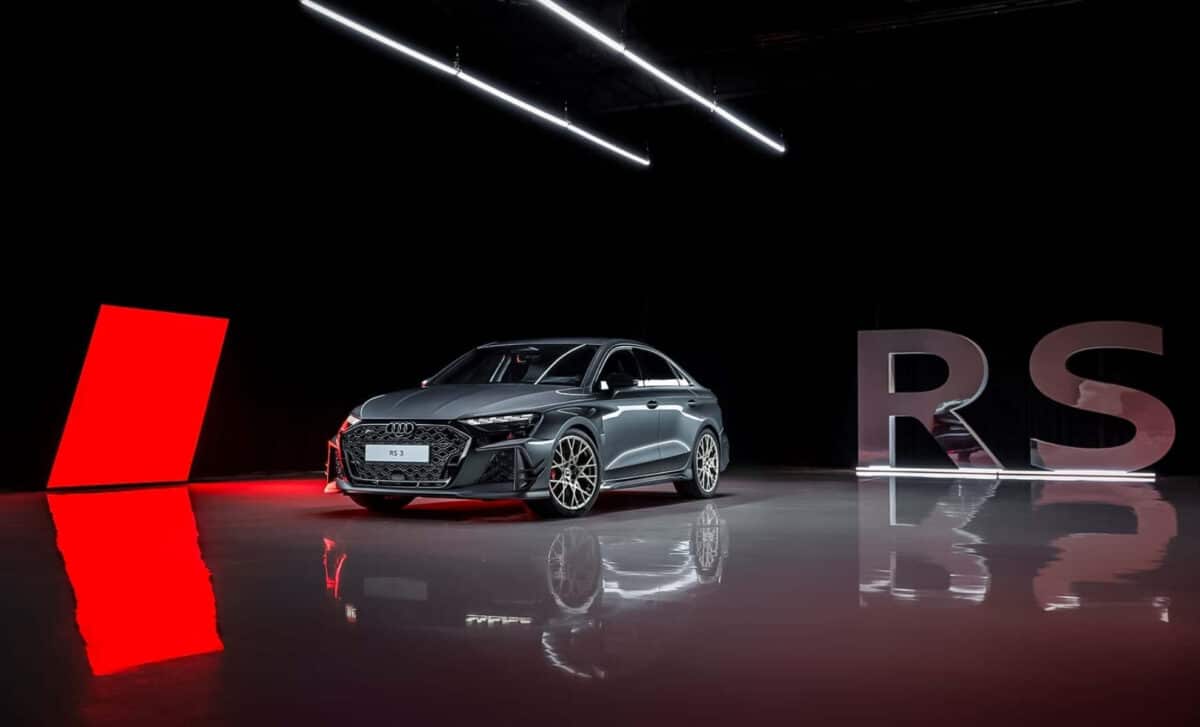
The announcement comes at a symbolic moment: Audi is marking 50 years of its iconic five-cylinder engine, a powerplant that has defined the brand’s performance identity across decades. But celebration and nostalgia walk hand in hand here. Stricter emissions regulations and the accelerating shift toward electrification mean the turbocharged 2.5-liter TFSI engine, in its current form, is almost certainly living on borrowed time. The RS3 Competition Limited, then, is framed not merely as a tribute, but as what could be the engine’s final curtain call.
The car arrives at a time when the broader automotive industry is in the middle of a painful transition. Legacy internal combustion icons are being retired one by one, and performance four-doors with character-laden engines are becoming increasingly rare. Audi, rather than letting the five-cylinder quietly fade out of the lineup, is choosing to mark the moment, which, depending on how you look at it, makes the RS3 Competition Limited either a celebration or a eulogy.
A Production Run Built on Scarcity
Audi will produce exactly 750 units of the RS3 Competition Limited worldwide, split between 585 Sportbacks and 165 sedans. Germany alone will receive 187 of those cars, 158 of which will be Sportbacks. For American enthusiasts, there’s a significant caveat: according to Motor1, the Sportback body style will almost certainly not make it to the United States, and pricing for the US market has not yet been announced.
Each car comes with a numbered plaque in the center console confirming its place in the production run, a detail that underscores just how deliberately Audi has positioned this as a collector’s item. Pricing in Germany starts at €100,680 (approximately $117,136) for the Sportback and €102,680 (around $119,472) for the sedan, which represents more than €44,000 above the base price of a standard RS3. Every Competition Limited, however, arrives fully equipped. Deliveries are scheduled to begin in June 2026.
Mechanical Sharpening, Not Reinvention
Under the hood, the formula is unchanged, and that’s very much intentional. The turbocharged 2.5-liter five-cylinder still produces 400 horsepower and 369 pound-feet of torque, hitting 62 miles per hour in 3.8 seconds and reaching an electronically limited top speed of 180 miles per hour.
The upgrades, instead, are about intensifying the experience. Audi removed approximately 8.8 pounds of sound-deadening material from the firewall between the engine bay and cabin, allowing the distinctive five-cylinder soundtrack to reach occupants more directly. The RS sport exhaust has also been recalibrated so that, in Dynamic, RS Performance, and RS Torque Rear driving modes, the exhaust valves open earlier, producing what Audi describes as a louder and more dramatic sound profile.
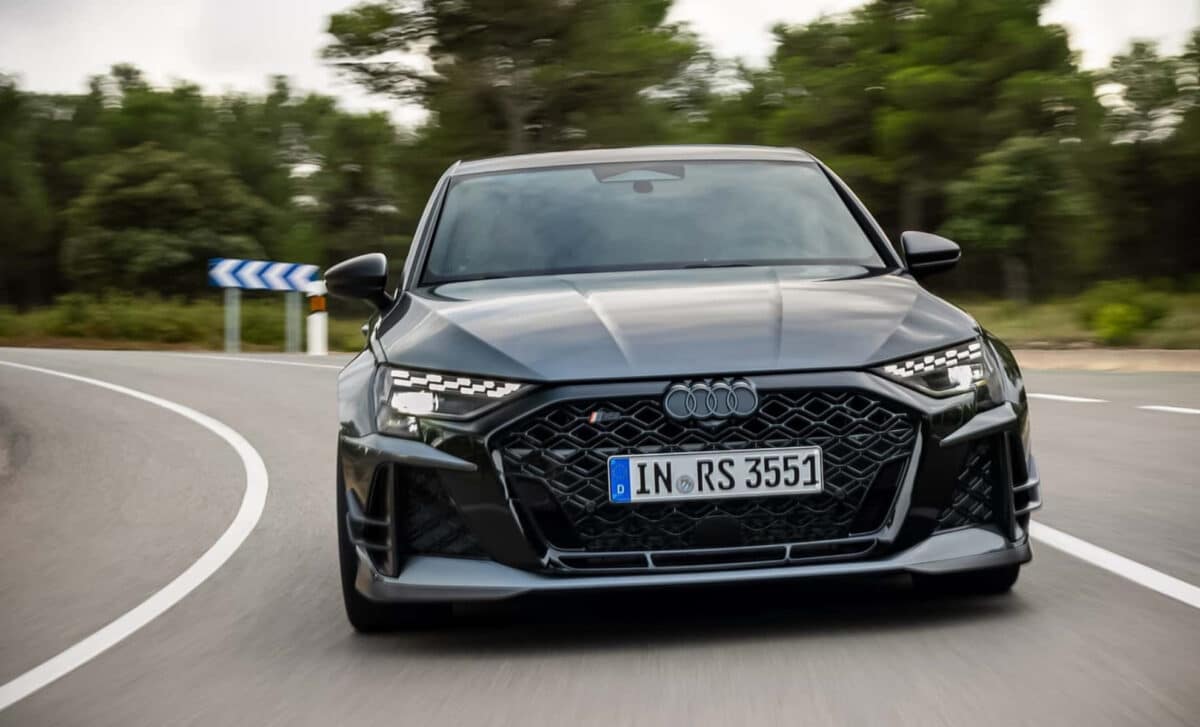
On the chassis side, the RS3 Competition Limited gains a factory-developed, model-specific coilover suspension for the first time, a notable first for the nameplate. The dampers offer three-way adjustment covering high- and low-speed compression as well as rebound. Ride height sits 10 millimeters lower than a standard RS3, and the car ships with a predefined road setup, along with a dedicated tool kit and instructions for owners who wish to fine-tune the settings themselves.
A thicker, stiffer tubular rear anti-roll bar and increased rear spring rates round out the handling upgrades. Carbon-ceramic brakes with red calipers are standard on the front axle, and optional Pirelli P Zero Trofeo R semi-slick tires are available for those seeking maximum grip.
Design Details That Speak to History
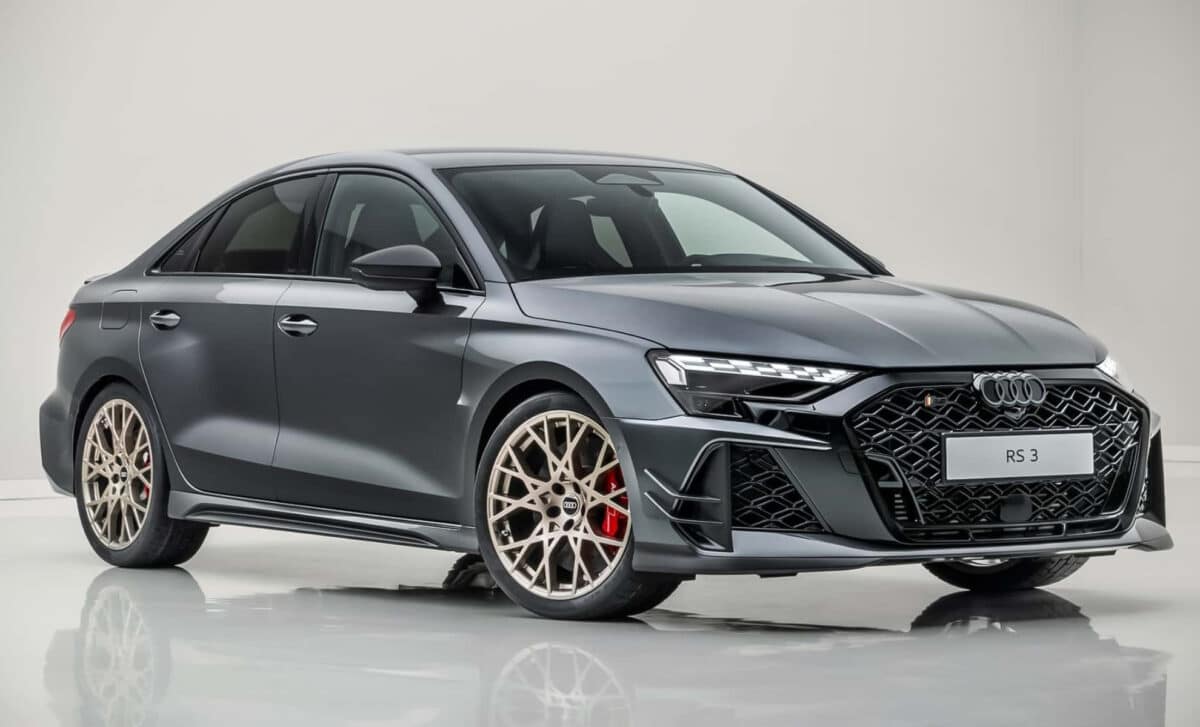
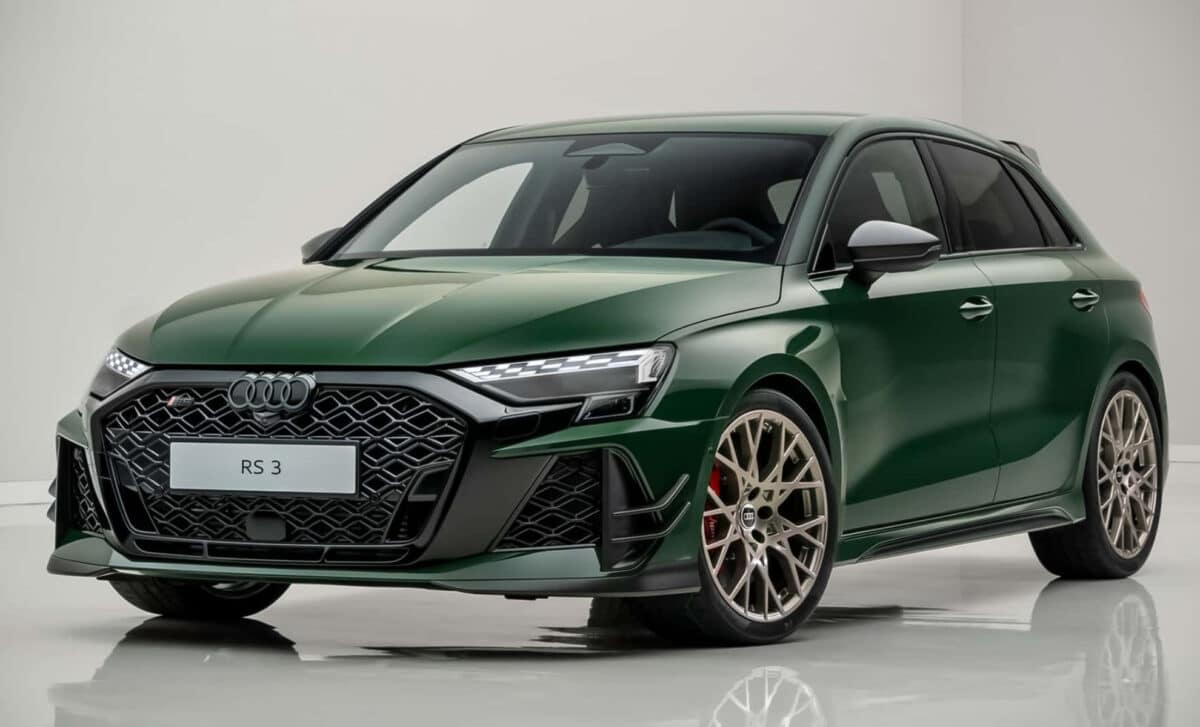
Visually, the Competition Limited leans hard into carbon fiber. Matte carbon appears across the split front spoiler, new bumper flics, side skirts, diffuser, and a prominent roof spoiler. Exclusive 19-inch forged wheels finished in matte Neodymium Gold fill the wheel arches.
Three paint options are available: Daytona Gray, a new matte Glacier White, and an exclusive Malachite Green, a direct reference to the original Audi Sport Quattro from 1983. There’s also a lighting detail that sits somewhere between engineering curiosity and brand storytelling: when locking or unlocking the car, the Matrix LED daytime running lights illuminate in the five-cylinder‘s firing order, 1-2-4-5-3.
Inside, deep RS bucket seats with carbon backs feature center sections trimmed in neodymium-gold Dinamica microfiber. The stitching, seat belts, and the 12-o’clock steering-wheel marker are finished in ginger white. The digital instrument cluster adopts white-background gauges, a nod to the analog dials found in the Audi RS2 Avant from 1994.