
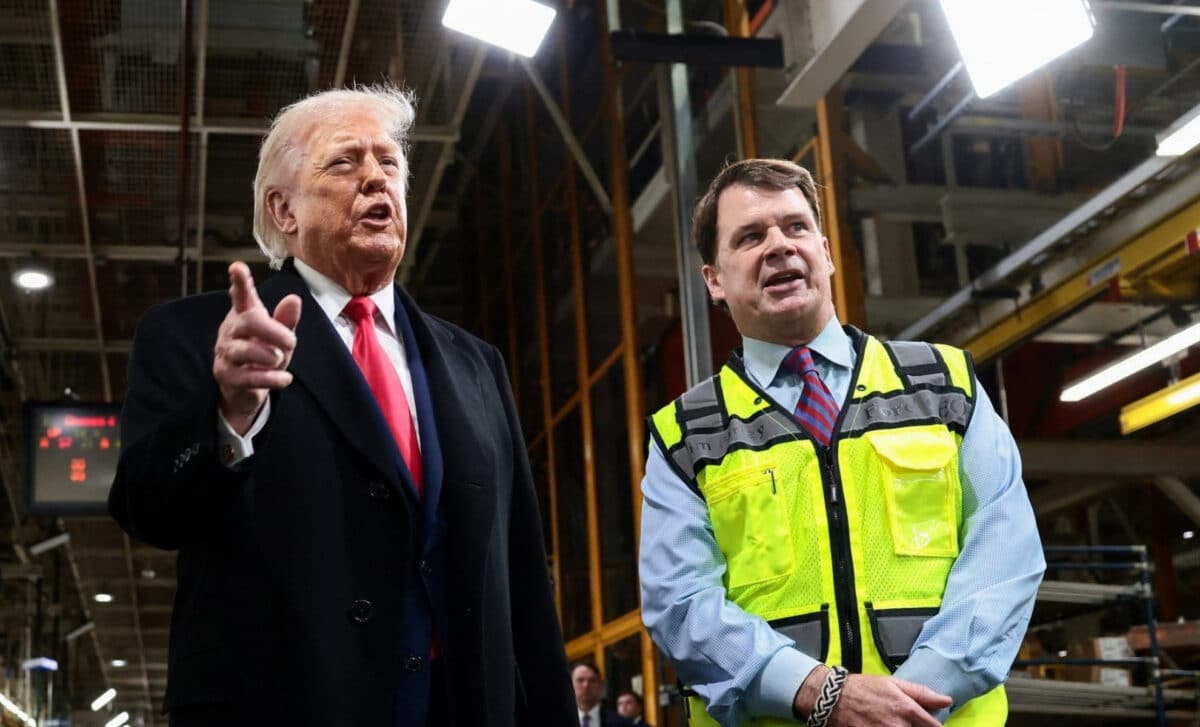
The decision follows a visit from president Donald Trump to the automaker’s Dearborn plant, where CEO Jim Farley confirmed the combustion vehicle shift in front of reporters.
The model will be built at Ford’s Blue Oval City site in Stanton, Tennessee, recently renamed the Tennessee Truck Plant, a facility initially developed for electric vehicle production. This abrupt change signals a broader shift in Ford’s EV roadmap, directly influenced by current political and market dynamics.
Ford’s pivot reflects growing concerns inside the company about slowing EV adoption and the financial toll of its electrification push. The change also underlines the automaker’s alignment with Trump-era policies, which include regulatory rollbacks and tariff protections. As Farley put it, the new gas-powered pickup is a response “to the president’s note,” highlighting how political messaging is shaping corporate strategy at the highest levels.
Farley Ties Combustion Shift to Trump-Era Policies
During the high-profile visit to Dearborn, Farley stood alongside Trump and Ford executive chairman Bill Ford to announce the reorientation. “We’re adding a combustion vehicle, a combustion truck, an affordable one, in Tennessee, to the president’s note,” Farley said to the press, echoing a direct response to Trump’s platform. He also confirmed the combustion model would replace the previously planned full-size electric truck.
Farley was later asked whether this shift was connected to Trump’s controversial trade tariffs. He responded with a simple “Yes, and the EPA,” before Trump interrupted to take credit: “his tariffs and the relief I gave them from the most ridiculous standards.” Just weeks earlier, Ford had quietly confirmed the name change of the Tennessee Electric Vehicle Center to Tennessee Truck Plant, solidifying the transition away from EV-focused manufacturing.
EV Pickup Project Shelved for Cheaper Combustion Model
The gas-powered truck will be produced in place of a full-size electric pickup originally slated for the same facility. The EV project was part of Ford’s larger electric strategy that is now being scaled back in favor of combustion and hybrid alternatives. Ford considers this shift a response to market demand and cost realities, rather than a full retreat from electrification.
Although details about the upcoming gas truck remain limited, it is officially part of the company’s long-term product plan. Production is expected to begin in 2029. In the meantime, the plant’s redesign reflects a significant redirection of industrial investment, one that aligns with policies Ford executives see as more favorable under Trump’s influence. The automaker’s leadership is keeping future options open, aware that the 2028 election could once again shift federal priorities on emissions and vehicle types.
WATCH: @Ford CEO @jimfarley98 says because of President Trump’s rollback of Biden-era CAFE standards, the company is able build a new, more affordable truck for Americans:
— Conservative War Machine (@WarMachineRR) January 13, 2026
“We are going to actually expand one of our existing plants and make a different kind of truck there.” pic.twitter.com/O3mqnMnlK8
Ford Takes $20 Billion Hit Amid Strategic Reset
Following the factory visit, Bill Ford addressed the financial consequences of walking back EV plans during the Detroit Auto Show. “Nobody likes to take that kind of write-down,” he said, referring to the $20 billion loss Ford absorbed while restructuring its electric strategy. “But I think it was really recognizing what reality was in the marketplace, that the aspirations we had, and the whole industry had, for the EV takeoff just wasn’t happening.”
Farley reiterated that the company isn’t abandoning EVs altogether. The plan going forward includes developing lower-cost electric vehicles and expanding gas-electric hybrid offerings. He cited the upcoming second-generation F-150 Lightning, which will no longer be fully electric but instead feature a range-extending system, as part of this more flexible approach.