
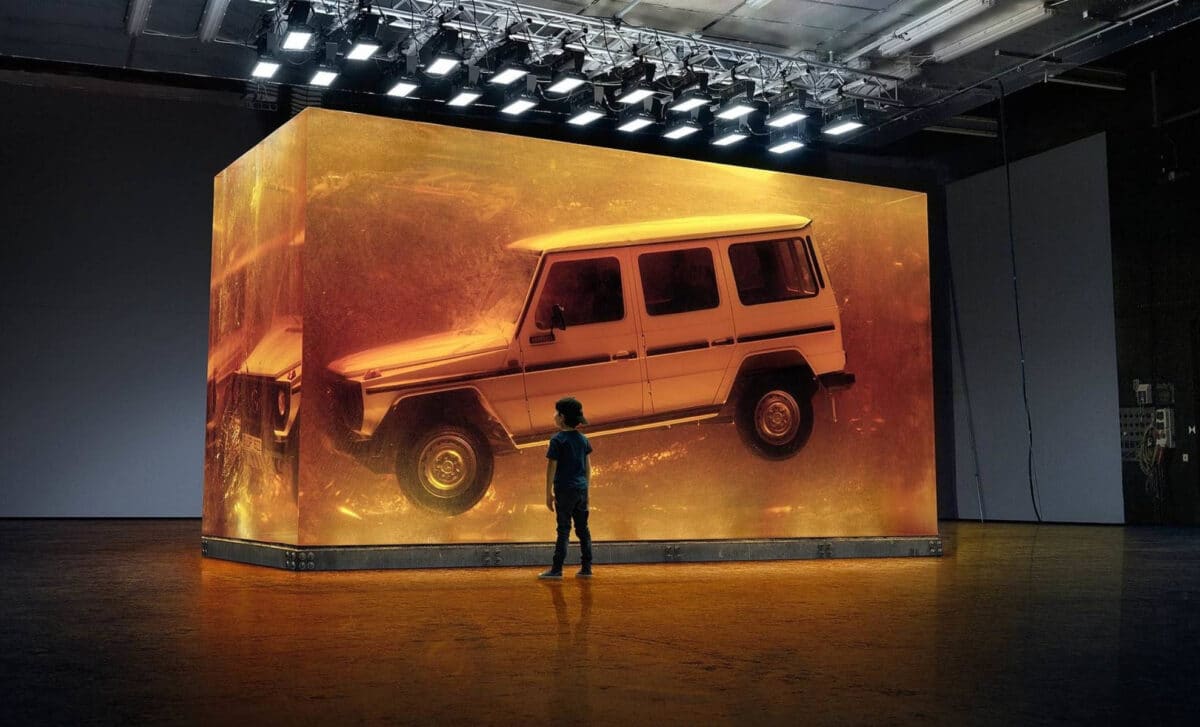
Unveiled at the 2018 Detroit Motor Show, the installation was created as part of a bold statement accompanying the launch of the brand’s new-generation G-Class. Designed to resemble a prehistoric fossil, the transparent cube turned a first-edition G-Wagen into a sculptural tribute to the model’s enduring legacy.
The project was anything but symbolic fluff. It took nearly 9,000 hours to complete and involved detailed engineering and materials typically not associated with auto manufacturing. The slogan “Stronger than time” underscored the brand’s message: while technology and trends evolve, the core DNA of the G-Class remains intact.
Introduced in 1979, the G-Class began as a utilitarian off-road vehicle developed for military purposes. Over the decades, it has evolved into a luxury icon without abandoning its rugged origins. The decision to preserve the original 280 GE model inside resin was Mercedes’ way of honoring the vehicle’s consistent identity. The amber cube wasn’t just for show, it captured the vehicle in motion, as though it had been off-roading straight into the fossilized future.
A 5.5-meter-long Fossil Made Of Resin
The installation was created using over 10,700 gallons of synthetic amber resin, poured in layers around a real 1979 G-Class placed inside a giant steel frame. The vehicle wasn’t positioned statically. Instead, it was tilted at a dynamic angle to simulate motion, enhancing the visual metaphor of it being “captured” mid-off-road drive, similar to how insects were preserved in ancient amber. The block grew by about three centimeters per day and took 90 days to complete.
The final structure measured 5.5 meters in length, 2.55 meters in width, and 3.1 meters in height. It was only once the resin had fully set that the frame could be removed, revealing the cube’s full scale. Mercedes-Benz stated the piece was intended to express the uniqueness of the G-Class in physical form.
“Our cult off-road vehicle has been continuously evolving for nearly 40 years, without losing its character or its core values,” said Dr. Gunnar Güthenke, Head of the Off-Road Vehicle product unit at Mercedes-Benz. “Its DNA is stronger than time and than any fashion trend. The cube expresses this to stunning effect and thus embodies the objective for advancing the G-Class,” he added, reports Supercar Blondie.
8,892 Hours Of Labor To Preserve One Car
The construction process totaled 8,892 hours. From the initial frame build to the final hardening of the resin, the project required a high level of precision. The vehicle had to be stabilized at an angle before the first layers of resin could be poured. Every step was designed to maintain both the integrity of the resin structure and the condition of the preserved vehicle inside.
Once the amber cube was presented to the public at the Detroit Motor Show, it didn’t remain in place for long. Mercedes-Benz transported the massive sculpture around the world as part of the G-Class global campaign. The cube functioned not only as a promotional piece but as a mobile art installation, a visual message about the legacy and longevity of the G-Class model.
The choice of resin and the amber hue were intentional. Beyond the aesthetic link to prehistoric fossils, the use of industrial resin created a durable, transparent enclosure capable of encasing a full-size SUV. This rare combination of automotive engineering and exhibition design reinforced the central idea: the G-Class is not just historic, it’s timeless.
A 1979 G-Class preserved forever inside 52 tons of amber resin pic.twitter.com/elkA5tmz5r
— Interesting As Fuck (@interesting_aIl) November 4, 2025
Mercedes Continues The Story With High-stakes Stunt
Just one year after the cube’s debut, Mercedes-Benz followed it up with a daring live-action demonstration to further highlight the G-Class’s strength. This time, the automaker turned to the Punta Negra dam in Argentina, where it filmed a G-Wagen driving across the dam’s 330-foot-high wall. The surface featured a near-vertical drop.
This challenge was intended to show that the G-Class is “stronger than gravity.” While the resin cube emphasized the vehicle’s endurance and symbolism, this physical stunt focused on raw performance and control. It served as a sharp contrast and a complement to the static installation. Together, the two projects highlighted how the G-Class balances heritage with capability, fossilized in time, yet still fully alive on extreme terrain.